

 English
 Español
 عربى

Hexagon Slotted Nuts: Standards, Slot Alignment, Torque and Sourcing Checks
Content
This guide covers what a hexagon slotted nut locks, the standards and height classes that change what it can carry, how slot alignment trades torque against pin fit, and the checks worth running before an incoming lot is approved.
What a Hexagon Slotted Nut Actually Locks
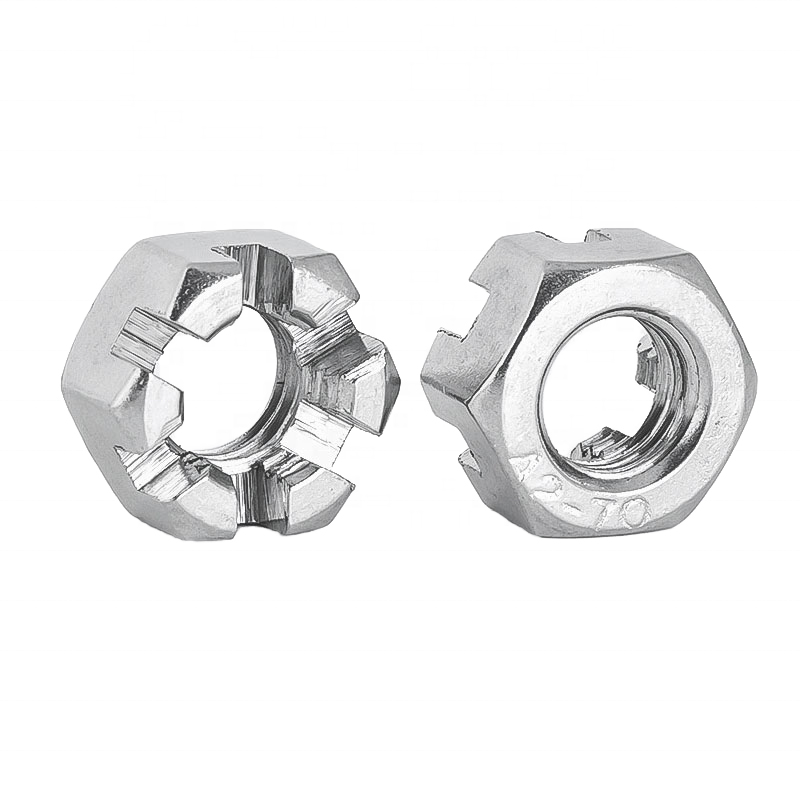
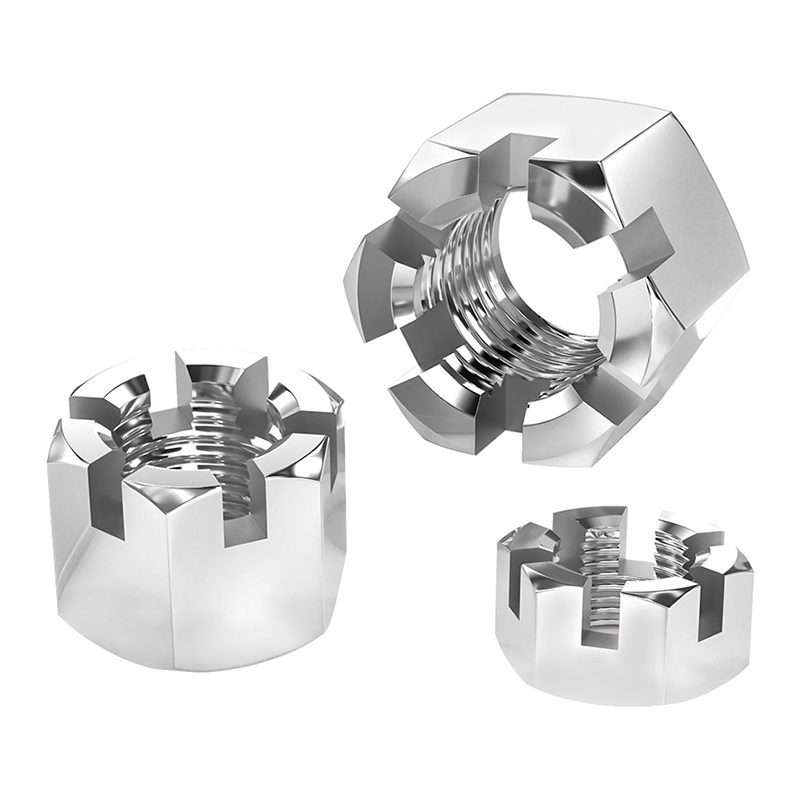
A hexagon slotted nut is a six-sided nut with slots cut into its top face, used with a bolt or stud drilled through the shank so that a pin through slot and hole blocks rotation.
The point that matters in design review is that this is a form-fit lock. The pin takes the rotation load in shear, so locking does not depend on clamp load, thread friction or temperature. That is why slotted nuts stay on wheel ends, steering linkages, propeller shafts, rod ends and rudder stocks, where a nylon collar would soften and a prevailing-torque nut could still creep.
- Locking is mechanical: the pin blocks rotation even after the joint settles and preload drops.
- No polymer element, so service temperature is set by the pin and coating rather than an insert.
- The lock is visible at inspection, which keeps it in regulated and safety-critical assemblies.
- The nut can be reused if threads and slots are sound; the pin cannot.
If you need the wider family picture first, our overview of what a nut is covers the taxonomy before you narrow down to a single standard.
Standards, Height Classes and What They Change
Metric hexagon slotted nuts are normally specified to DIN 935-1 at full height or DIN 979 in the thin pattern, while inch-series parts follow ASME B18.2.2; the height class, not the thread, is what changes the load a nut can carry.
| Family | Typical sizes | Height class | Usual role |
| DIN 935-1 | M5 and up, coarse or fine | Full | Spindle and axle nuts, rod ends, linkages, general machinery |
| DIN 979 | M5 to M36 | Thin | Jam or locking nut behind a full nut, tight envelopes |
| ASME B18.2.2 slotted | 1/4 in and up | Full | Trailers, agricultural and off-road equipment built to inch drawings |
| ISO 7035 | M5 to M36 | Thin | Where an ISO drawing calls for a thin slotted nut |
Slot geometry is also not fully interchangeable between standards. Slot width, slot depth and the position of the slots relative to the hex corners differ, so a pin that fits a DIN 935-1 nut can be a loose fit in a thin pattern from another source.
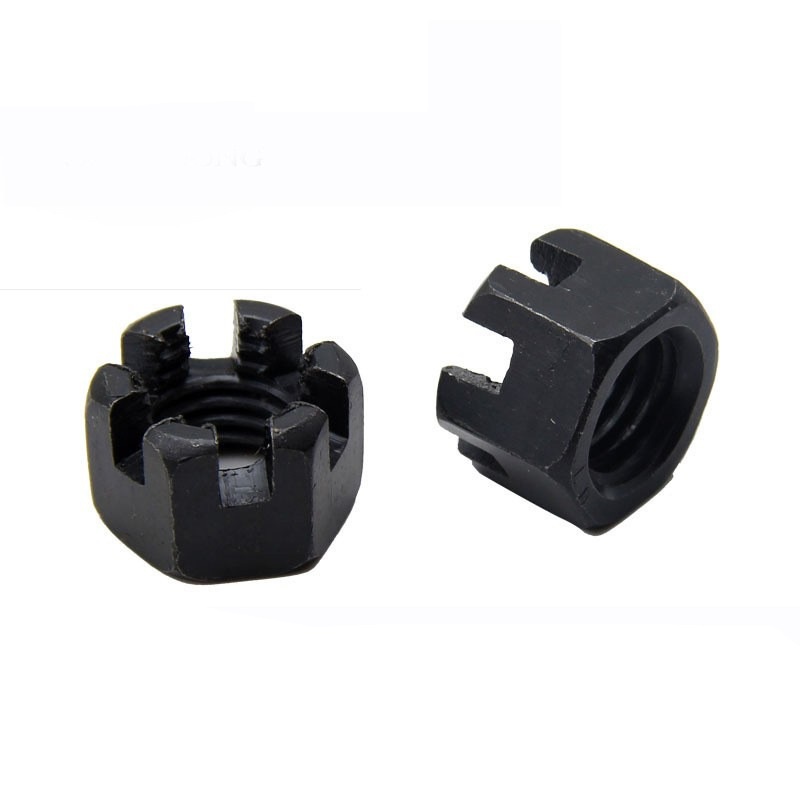 DIN 935-1 Hexagon Slotted Nut with Coarse and Fine ThreadsDIN 935-1 slotted hex nuts support cotter-pin retention and are offered in coarse or fine thread, with size data from M4 to M100.View Product →
Fine pitch is worth specifying on spindles and adjusters. The same wrench rotation moves the nut a shorter axial distance, so adjustment holds better under vibration and the pin has less travel to absorb.
Slot Alignment, Preload and the Torque Window
Slot alignment turns a torque figure into a torque window, because the pin hole only meets a slot once every 60 degrees of nut rotation.
Advancing by one slot moves the nut along the thread by one sixth of the pitch. On an M20 x 2.5 that is about 0.42 mm of axial travel; on a 1/2-20 UNF it is about 0.21 mm. Small numbers, but often larger than the gap between the minimum and maximum torque you would accept on a bearing adjustment, which is exactly how a fitter ends up choosing between an over-torqued bearing and a backed-off nut.
- Check the drilled hole before assembly: diameter, position under the slot area, and no burrs that would stop the pin seating.
- Torque in two or three stages to the lower half of the specified range, with the nut running freely on clean threads.
- Advance only, to the first slot that lines up with the hole, and record the final torque.
- Fit the split pin so the eye sits against the nut face and both legs pass through slot and hole.
- Bend one leg over the top of the nut and the other down the side, then scrap the pin if it has been opened twice.
Slotted Nuts Versus Other Locking Methods
Use a slotted nut when the joint runs hot, rotates in service or must be verified visually; use a prevailing-torque nut when the shank cannot be drilled or the assembly needs continuous adjustment.
Slotted nut with split pin
- Locks without relying on clamp load, so it holds after the joint settles.
- Unaffected by heat, solvents and washdown.
- Visible at inspection and easy to audit on a line.
- Needs a drilled shank and a hole position matched to nut height.
- Torque is quantised to 60 degree steps.
Nylon insert or all-metal lock nut
- No drilling and no extra component at assembly.
- Continuous adjustment, no slot quantisation.
- Reusable several times, particularly the all-metal type.
- Nylon softens above roughly 120 C, which rules out hot joints.
- Prevailing torque drops after repeated assembly.
A third option, safety wire through a drilled nut and bolt head, gives the same positive lock and is standard in aerospace and motorsport, but it is slower to assemble and harder to audit than one pin through one slot.
Sourcing Checks Before a Lot Is Approved
The details that most often go wrong in a slotted nut order are slot width, height class and thread tolerance class, and all three are cheap to verify on a sample.
- Slot width against the pin you actually use. Specify the two as a pair; a slot far wider than the pin lets it rock and wears both hole and slot.
- Height class. Confirm the drawing says DIN 935-1 for full height or DIN 979 for thin, because substituting one for the other changes proof load and pin position.
- Thread tolerance. 6H for metric, 2B for inch; mixed-class lots gall and produce false torque readings.
- Property class and material. Class 8 or 10 in carbon steel, A2-70 or A4-80 in stainless, with a lubricant specified for stainless to limit cold welding.
- Coating and embrittlement. Electroplated high-strength nuts need a post-plate bake; zinc flake coatings avoid the question.
Thin patterns are the ones buyers source late, because they get treated as an accessory to the full nut in front of them.
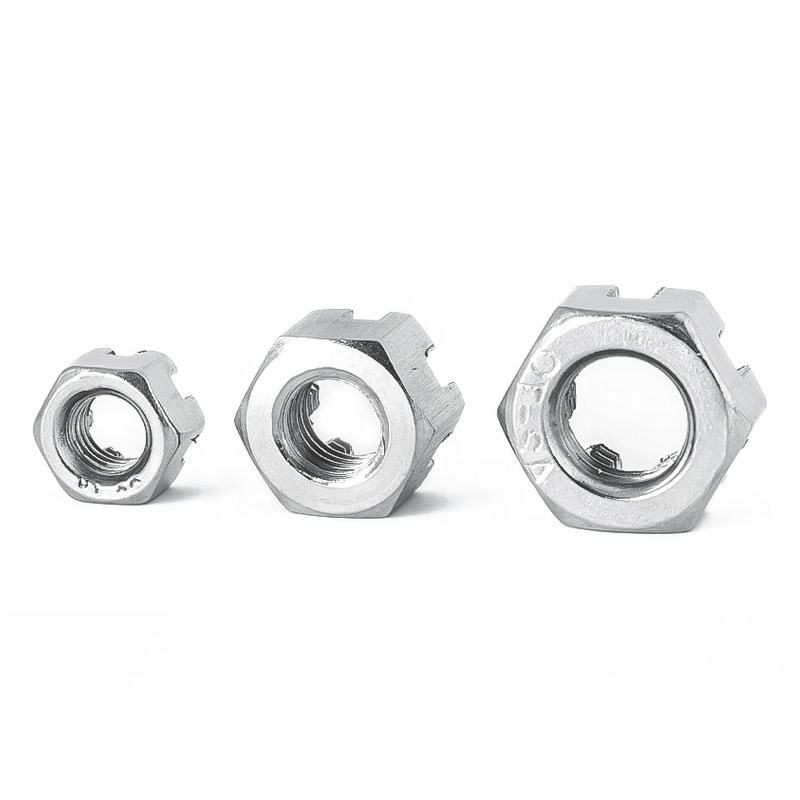 DIN 979 Hexagon Slotted Thin Nut for Compact LockingThis low-height DIN 979 slotted nut saves axial space while allowing cotter-pin locking, with millimeter dimensions for M6 through M52 and optional sizes.View Product →
For inch drawings the ASME B18.2.2 slotted nut is the default, and its slot depth and width follow table dimensions rather than the metric pattern, so the pin has to be ordered with it.
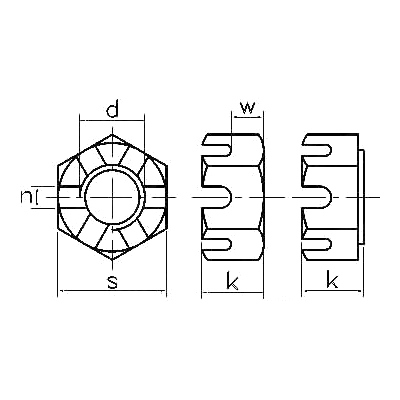 ASME/ANSI B18.2.2 Hexagon Slotted Nut, Inch ThreadsThe ASME B18.2.2 slotted hex nut provides visible anti-loosening for inch fastening systems, with size data from 1/4 through 1-1/2 inch.View Product →
Metric and inch slotted ranges are catalogued together under hexagon slotted nuts, listed by standard, thread and height so the pin, the nut and the washer can be checked as one set.
Frequently Asked Questions
Are hexagon slotted nuts reusable?
Yes, the nut is reusable while slots, threads and bearing face are undamaged and the thread still passes a gauge check. The split pin is not: a pin that has been straightened and refitted has lost its spring and should be replaced at every assembly.
What is the difference between DIN 935-1 and DIN 979?
Height. DIN 935-1 is the full-height metric slotted nut for load-bearing joints, while DIN 979 is the thin version, normally a locking or jam nut behind a full nut or a solution for a tight envelope. Both take a pin, but they do not carry the same proof load.
Can a slotted nut be used without a pin?
It can be assembled, but it locks nothing. Without a pin the nut behaves as a plain hex nut with reduced bearing area and will back off under vibration like any unlocked nut. If the shank cannot be drilled, specify a prevailing-torque nut instead.
Which pin should be used with a castellated nut?
A split cotter pin sized to the drilled hole, to ISO 1234 or DIN 94, long enough to pass through the nut and bend. The pin should fill the hole without force and should not be replaced by wire unless the drawing calls for safety wire.
OUR PRODUCTS
Related Products
CONTACT DETAILS
-
 Address:Room 1901-4, Building 1, Eastern Chuangzhi Mansion, Baiyang Street, Qiantang District, Hangzhou City, Zhejiang Province, China
-
 phone:+86-0571 85382212
-
 E-Mail:export@betterfastener.com
-
 Whatsapp:+86 15372362589
QUICK LINK
PRODUCTS
QR CODE
Copyright © 2026 Better Fastener Industry Co., Ltd. All Rights Reserved. Fastener Manufacturers in China Custom Fastener Factory



