

 English
  Español
  عربى
عربى 
Hexagon Flange Nuts: Standards, Sizes, Torque Values and Sourcing Guide
Content
- 1 What a Hexagon Flange Nut Does in a Joint
- 2 Standards, Sizes and the Data That Belongs on a Drawing
- 3 Serrated or Smooth Flange: The Choice That Causes Most Field Problems
- 4 Torque, Preload and What the Flange Changes
- 5 Materials, Coatings and a Working Sourcing Checklist
- 6 Frequently Asked Questions About Hexagon Flange Nuts
A joint that calls for a bolt, a flat washer and a lock washer is a joint with three supply lines, three bin locations and three chances of the wrong part reaching the assembly line. That is why hexagon flange nuts hold such a large share of high-volume work: the washer is formed into the nut, the bearing area is fixed by the standard, and the bill of materials loses two line items.
Nothing in that trade is free. The flange sets the bearing diameter whether your hole, fillet or coating likes it or not, and a serrated flange marks every surface it touches. What follows covers what the flange actually changes in a bolted joint, which standard data belongs on a purchase order, and the places where flange nuts cause more trouble than the washer stack they replaced.
Short version: one flange nut replaces a nut plus a washer, the flange spreads clamp load over a washer-sized footprint, and serrated versions add prevailing torque without a nylon insert.
What a Hexagon Flange Nut Does in a Joint
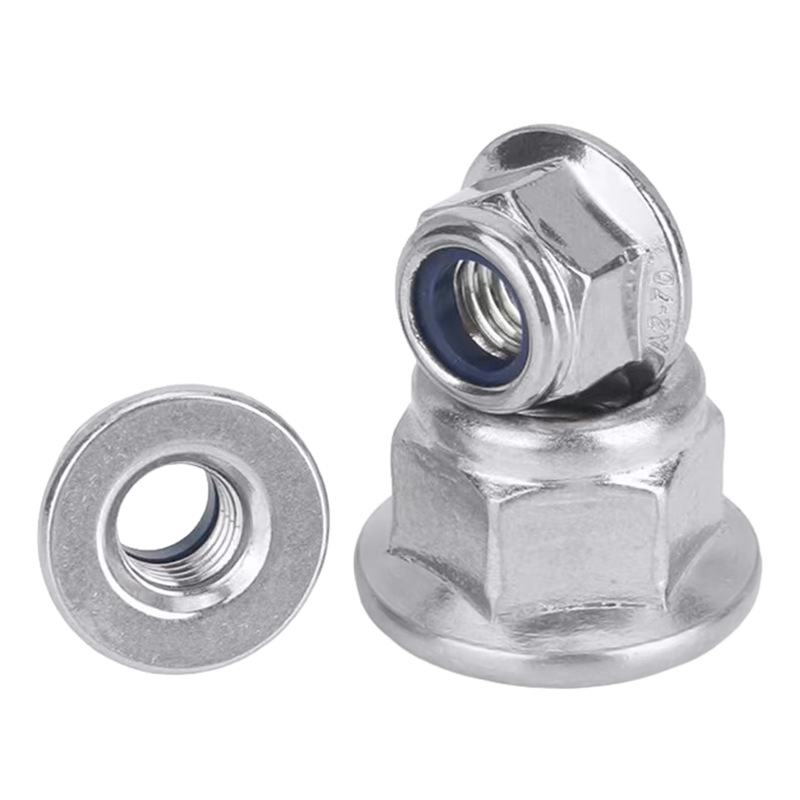
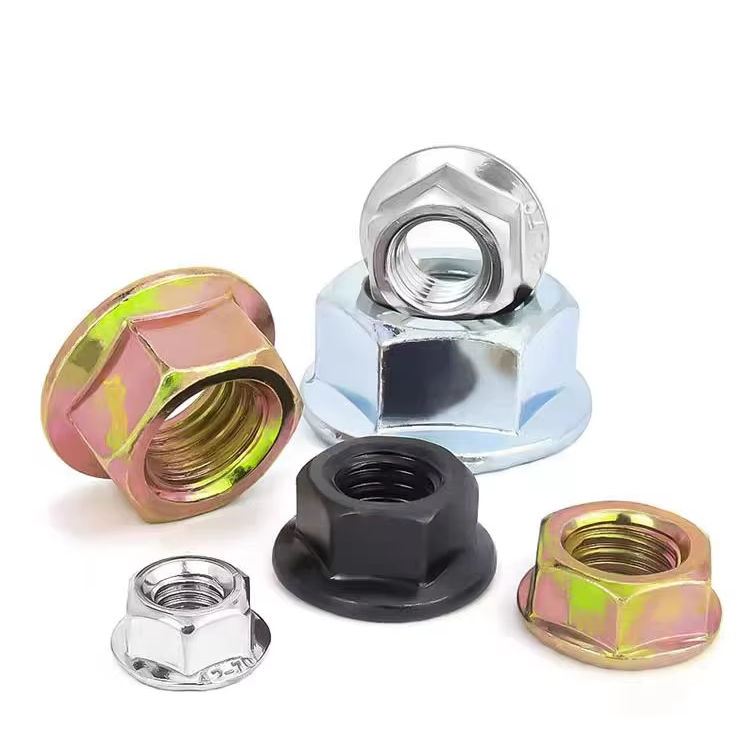
A hexagon flange nut is a six-sided nut with a wide circular collar formed at the bearing end, so the nut itself spreads clamp load over a washer-sized area and no separate washer is required.
DefinitionThe collar usually measures about 1.4 times the width across flats. On an M8 nut with a 13 mm hex, the flange runs roughly 17.9 mm across, which is close to or slightly wider than the 16 mm outside diameter of a standard M8 flat washer.
Three things change once the washer becomes part of the nut:
- Bearing pressure falls, because the same clamp load is spread over a larger ring. That matters on aluminium, thin sheet and die-cast housings, where a plain hex nut embeds and quietly loses preload.
- Part count drops from two to one, so there is no washer to be omitted, doubled up, or replaced with the wrong hardness grade.
- The bearing diameter is no longer adjustable. A washer can be swapped for a larger one; a flange cannot.
The load path itself does not change, only the surface it presses against. If you want a quick refresher on that path, our note on what a nut does in a bolted joint walks through it.
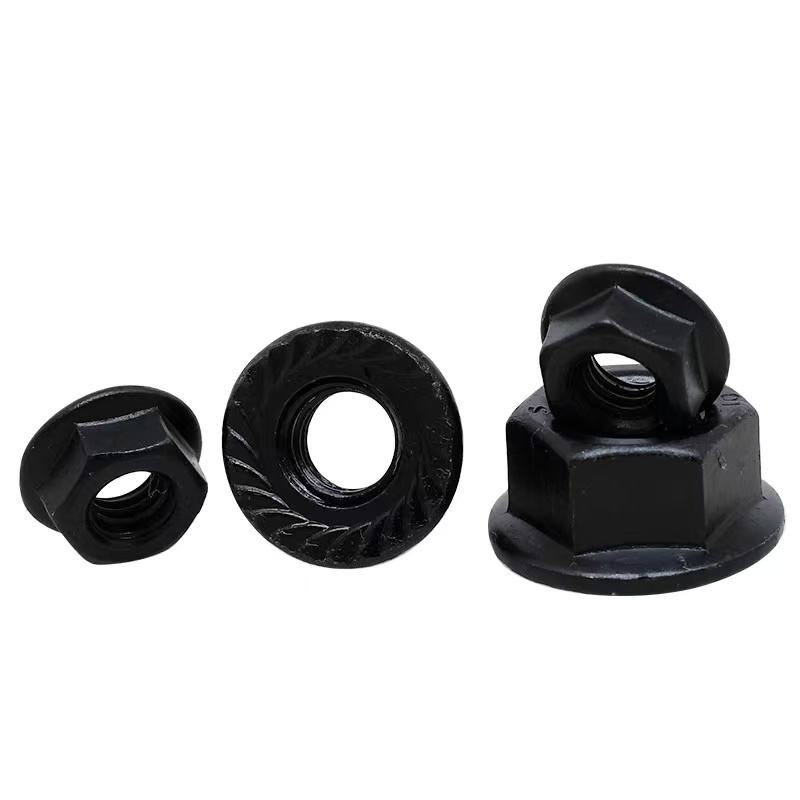 DIN 6923:1983 Hexagon Flange NutDIN 6923:1983 Hex Flange Nut integrates a flange bearing surface, increasing contact area without the need for a separate flat washer. The flange helps distribute clam...View Product →
Standards, Sizes and the Data That Belongs on a Drawing
Specify a hexagon flange nut by standard edition, flange type and property class, because a thread size alone is not a specification.
Metric smooth-flange nuts are normally ordered to DIN 6923 or the matching ISO and EN editions, inch-series versions to ASME/ANSI B18.2.2 T12HF, and serrated prevailing-torque versions to DIN 6927 or the inch IFI-145 style. Property classes 8, 10 and 12 cover most industrial work, and the class marking is stamped into the bearing face or the side of the hex so it survives plating.
| Nominal size | Coarse pitch | Width across flats | Flange diameter | Nut height |
| M6 | 1.0 | 10 | 14.2 | 6 |
| M8 | 1.25 | 13 | 17.9 | 8 |
| M10 | 1.5 | 15 or 16 | 21.8 | 10 |
| M12 | 1.75 | 18 | 26.0 | 12 |
| M16 | 2.0 | 24 | 34.5 | 16 |
Two details catch buyers out. The flange diameter drives clearance, and the collar has to seat flat, so a fillet, a weld bead or a raised boss under the nut makes it rock and lose preload. Then there is the M10 socket question: some editions list a 16 mm width across flats where older drawings assume 15 mm, which shows up as a wrong socket on the line rather than a wrong nut.
Check before you buy: in most size ranges a flange nut is taller than a standard hex nut of the same thread, and that extra height is what pays for the flange.
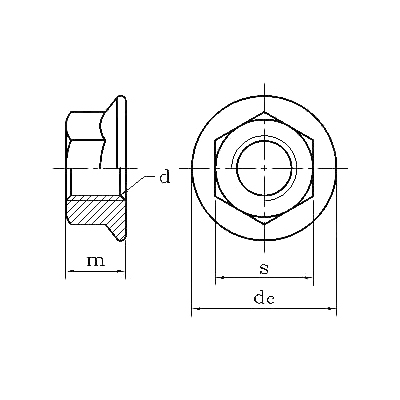 ASME/ANSI B18.2.2 (T12-HF):2010 Hexagon Flange NutASME/ANSI B18.2.2 (T12-HF):2010 Hex Flange Nut is designed for inch-series connections requiring a larger bearing area and simplified assembly. The flange face can rep...View Product →
Serrated or Smooth Flange: The Choice That Causes Most Field Problems
Choose a serrated flange nut when you need extra resistance to vibration and can accept the teeth marking the mating surface; choose a smooth flange nut when that surface is painted, plated, thin, or part of an electrical or sealing joint.
Smooth flange
- Keeps painted and plated finishes intact
- Lets the joint slide and align before final torque
- Lower galling risk on stainless assemblies
- Needs a separate locking feature when vibration is severe
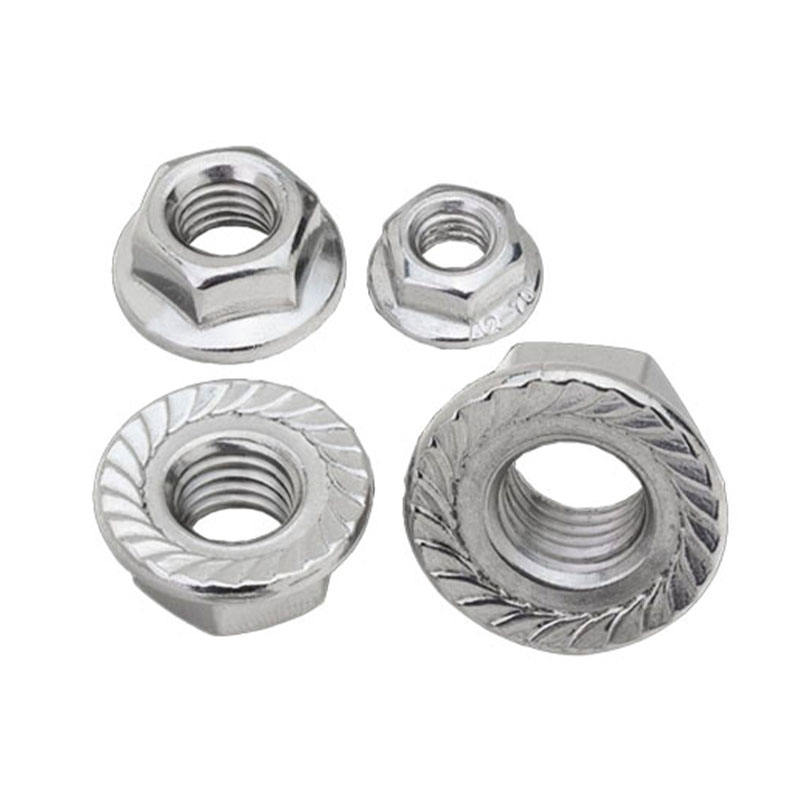
Serrated flange
- Teeth bite the surface and add prevailing torque
- Resists loosening without a nylon insert
- Intended for a single installation in critical joints
- Cuts through coatings and can crack thin or brittle parts
Watch the coating, not just the torque. A serrated flange scratches the corrosion barrier on the plate every time it is tightened. On galvanised or painted steel outdoors, that scratch is where rust starts, and on stainless hardware the same teeth are a common cause of galling that seizes the nut onto the stud.
Where the seating face is uneven or the joint has to align itself, a self-aligning flange nut with a spherical seat does the job neither flat type can. It costs more per piece and is normally reserved for drawn or cast components whose faces cannot be machined flat.
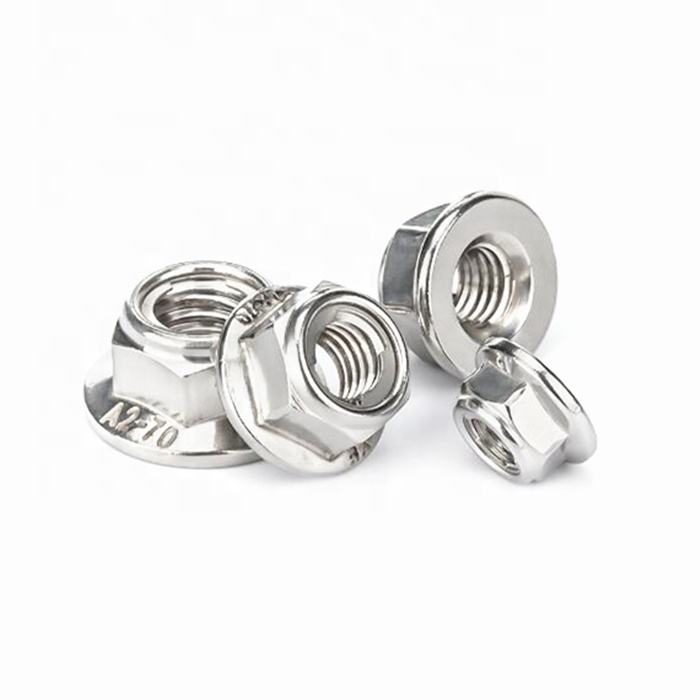 DIN 6927:1983 All Metal Lock Hex Flange NutDIN 6927:1983 All-Metal Lock Hex Flange Nut integrates a flange bearing surface with an all-metal locking function, making it suitable for compact joints under vibrati...View Product →
Torque, Preload and What the Flange Changes
Flange nuts do not change the torque to preload relationship itself, but they do change the friction split, because bearing friction now acts at a larger radius than it does under a plain nut.
In practice the effect is modest and it is already built into published torque tables for flange hardware. What you should not do is take a figure written for a hex nut plus a hardened washer and assume the flange version behaves identically. Typical dry tightening torques for property class 8 nuts sit in this range:
Rule of thumb: treat the flange as a washer for bearing pressure, but keep the torque value attached to the nut, the class and the joint, not to the washer the nut replaced.
Three variables decide whether the joint holds:
- Embedment: soft or rough surfaces let the collar sink, and preload disappears with it.
- Friction: dry, oiled and zinc-flake surfaces sit at very different friction levels, and the same wrench setting can move clamp load by 30 percent or more.
- Reuse: serrated and all-metal lock versions lose most of their prevailing torque after the first installation, so a joint opened for maintenance should get a new nut.
Materials, Coatings and a Working Sourcing Checklist
Match the material and coating to the environment first, then confirm the standard and flange type, because a correctly sized nut in the wrong finish fails faster than a slightly oversized one with the right coating.
- Carbon steel in classes 8, 10 and 12 with zinc plating covers most indoor machinery and costs least per piece.
- Hot dip galvanised nuts need an over-tapped thread or extra clearance, because the coating adds 40 to 80 microns per thread flank and a standard nut will not run down the bolt.
- Zinc-nickel and zinc-flake finishes are specified where salt spray expectations run past 500 hours, such as underbody and coastal equipment.
- Stainless A2 and A4 flange nuts should be smooth-flange, with a lubricant or a slower tightening speed, to avoid galling.
- Nylon-insert lock flange nuts suit joints that are adjusted often, because they hold prevailing torque through several cycles.
The flange protects the joint surface, not the fastener. When the coating on the plate is the corrosion barrier, a serrated flange puts a hole in that barrier at every tightening.
Once the specification is fixed, a short checklist keeps the order clean:
Name the standard edition
DIN 6923, ASME B18.2.2 T12HF, DIN 6927 or IFI-145, with the year of the edition, so a lookalike cannot be substituted.
Fix the flange type
Smooth, serrated or self-aligning, and state plainly whether the joint face may be marked.
Fix class and material
Property class 8, 10 or 12, or A2 and A4 stainless, together with the marking requirement.
Fix the coating and the test
Plating thickness, salt spray hours and the acceptance method, agreed before the first shipment rather than after it.
Fix packaging and traceability
Carton counts, labelling and heat lot traceability, so a failure at the line can be traced back to a melt.
We build flange nuts and the washers they were designed to replace, alongside the rest of our fastener range, which means one drawing and one coating conversation covers both sides of the joint.
Frequently Asked Questions About Hexagon Flange Nuts
Do hexagon flange nuts need a washer?
No. The flange is the washer. Adding a flat washer under a flange nut enlarges the bearing area slightly but also adds a second part, a second friction surface and a second chance of the wrong washer being fitted, so only add one when a drawing calls for it.
What is the difference between DIN 6923 and DIN 6927?
DIN 6923 covers a smooth-flange hexagon nut, while DIN 6927 covers a hexagon flange nut with serrations and an all-metal prevailing torque feature. Threads and hex look identical at a glance, and the flange face is the fastest way to tell them apart on the bench.
Can a serrated flange nut be reused?
Once or twice at most, and never in a critical joint. The teeth flatten with each tightening, so the prevailing torque that resists vibration drops sharply after the first installation. For maintenance joints, a nylon-insert lock flange nut holds up better across repeated cycles.
Are flange nuts stronger than standard hex nuts?
No. Strength comes from the property class, not from the flange. A class 8 flange nut carries the same proof load as a class 8 hex nut of the same thread. The flange changes bearing pressure and part count, not the load the nut can carry.
OUR PRODUCTS
Related Products

CONTACT DETAILS
-
 Address:Room 1901-4, Building 1, Eastern Chuangzhi Mansion, Baiyang Street, Qiantang District, Hangzhou City, Zhejiang Province, China
-
 phone:+86-0571 85382212
-
 E-Mail:export@betterfastener.com
-
 Whatsapp:+86 15372362589
QUICK LINK
PRODUCTS
QR CODE
Copyright © 2026 Better Fastener Industry Co., Ltd. All Rights Reserved. Fastener Manufacturers in China Custom Fastener Factory



