

 English
 Español
 عربى

Slotted Screws Explained: Head Styles, Standards, Tolerances, Sourcing
Content
A purchase order that reads only "slotted screws, M4 x 12, stainless" leaves the supplier guessing at four things: head style, slot width, property class and the edition of the standard behind the drawing. Any one of those guesses can turn into a rejected lot or a stripped slot on the line. The notes below cover what the drive actually is, where it still earns its place, how the common standards map to head shapes, and which checks belong in an incoming inspection plan.
What a slotted screw is
A slotted screw is a threaded fastener with one straight slot cut across the head, driven by a flat blade whose tip width matches the slot width.
The drive geometry explains most of the behaviour buyers notice later. Torque passes through two parallel slot walls, so the contact area is small, and the blade has no taper to centre itself in the slot. If the surrounding vocabulary is still unfamiliar, our overview of what a screw is covers the head, shank and thread terms used here.
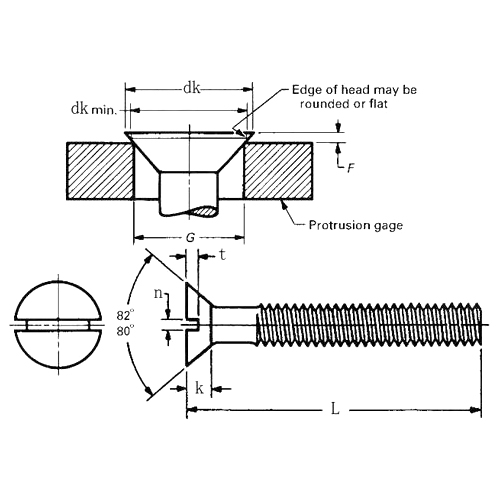
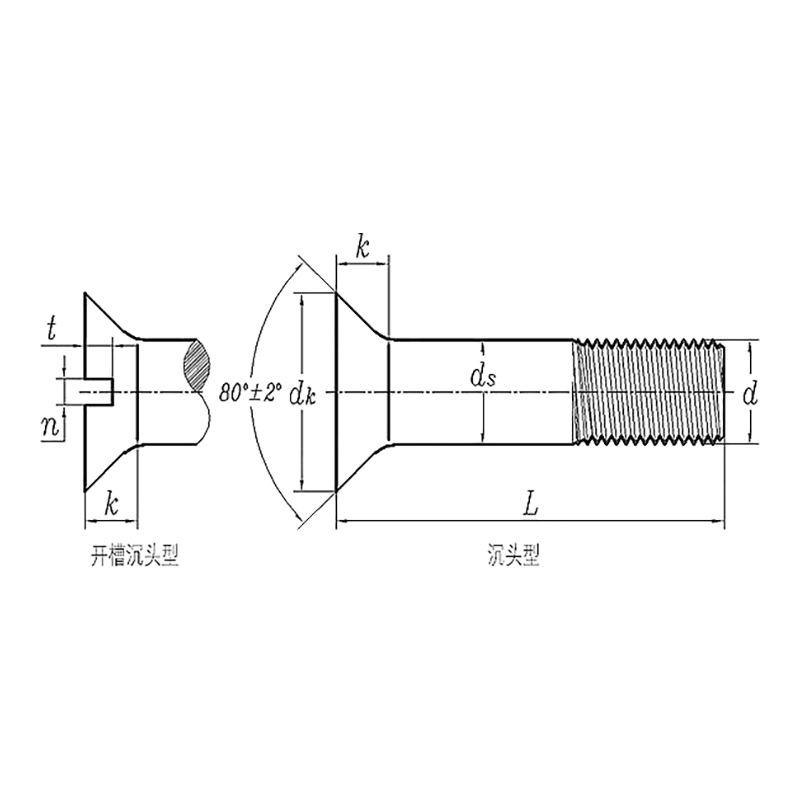
Working definition: slot width (n) and slot depth (t) decide whether the screw can be driven without damage, while head diameter (dk) and head height (k) decide how it seats. Quote all four on the drawing when the joint is safety related.
Slotted is a drive designation, not a head style. The same single slot appears on cheese head machine screws, pan heads, countersunk heads and oval countersunk heads, and it also appears on wood screws and tapping screws. That distinction matters at quotation stage, because "slotted screw" on its own does not identify a drawing.
- Two contact faces carry the torque, so the slot walls, not the thread, usually set the practical limit.
- No self-centring taper means the operator aligns the blade by hand before any load is applied.
- Blade thickness matters as much as blade width, because a thick tip bottoms out in the slot and lifts the edge out.
Why slotted drives survive in specification
Slotted screws survive because the tool is universal and the part costs little to produce, not because the drive performs well under load.
That sounds like faint praise, and for high-volume assembly it is. Yet a maintenance engineer with a single flat blade in a tool bag will finish the job, while a technician hunting for the right insert bit will not. Three numbers sum up the trade.
In practice, slotted fasteners stay in the catalogue for a short list of jobs:
Rule of thumb: keep slotted where the joint is dismantled by hand, torque demand is modest, and tool availability matters more than assembly speed.
The costs appear as soon as cycles matter. A flat blade has to be aligned before torque, so automated driving is slower and less reliable, and cam-out damage to the slot is common once the blade is worn. On joints that hold preload or see vibration, a recessed or internal drive is usually the better choice.
Slotted versus cross-recessed, hex socket and Torx
Slotted drives give up torque capacity and assembly speed in exchange for tool ubiquity and the lowest tooling cost of any recess.
Slotted
- Any flat blade will turn it
- Single-die, low-cost heads
- Limited torque, no self-centring
Cross-recessed
- Self-centring taper
- Fast power driving
- Cam-out risk at high torque
Hex socket and Torx
- Highest torque for head size
- Suited to automated assembly
- Requires the matching bit
Choose slotted for repair, legacy drawings and low-volume builds; move to a recessed or internal drive once the joint is assembled on a line or has to hold preload.
Two practical signals usually settle the decision. If the drawing already names a slotted standard, matching it avoids requalification. If the joint has a tightening torque the slot cannot survive without blade slip, the drive is wrong regardless of unit cost.
Head styles and the standards to quote
Slotted screws are specified by head style plus standard, because the same head shape appears in DIN, ISO and ASME families with different dimensions and tolerances.
| Head style | Metric reference | Inch reference | Typical application |
| Cheese head | DIN 84, ISO 1207 | ASME B18.6.3 | Older machine assemblies |
| Pan head | DIN 85, ISO 1580 | ASME B18.6.3 | General assembly, electrical fittings |
| Countersunk head | DIN 963, ISO 2009 | ASME B18.6.3 | Flush seating in plates and panels |
| Raised countersunk head | DIN 964, ISO 2010 | ASME B18.6.3 | Hinges and decorative flush fits |
| Wood screw, countersunk | DIN 97 | ASME B18.6.1 | Joinery and furniture repair |
| Tapping screw, pan head | DIN 7971 | ASME B18.6.4 | Sheet metal and plastics |
| Set screw, cup point | DIN 438 | ASME B18.6.2 | Collar and shaft locking |
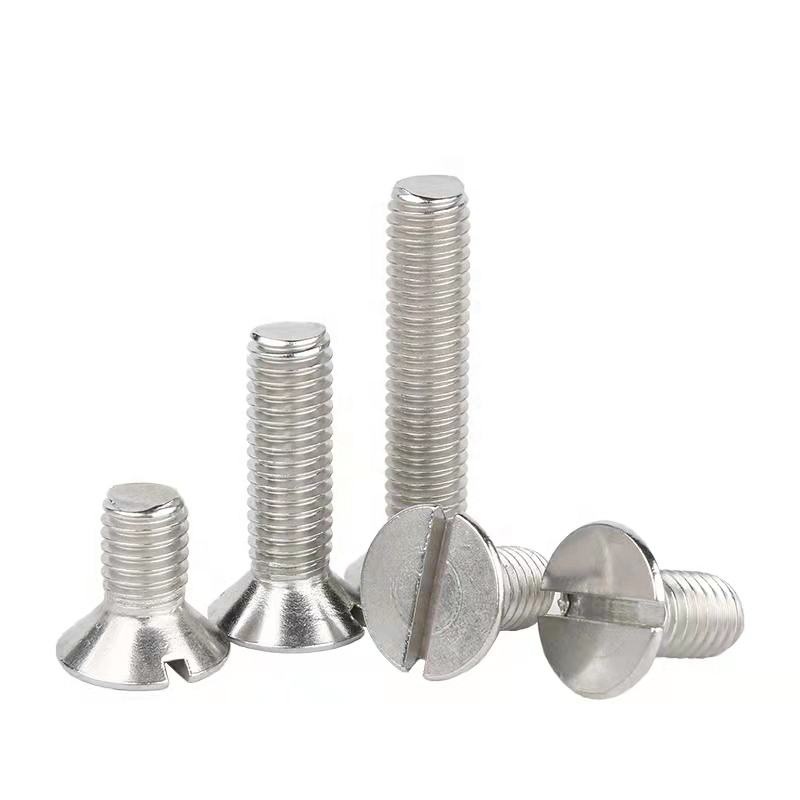 DIN 963:1990 Countersunk Head Slotted ScrewStandardized countersunk slotted screw; its dimensional table helps quote DIN 963:1990 with year and check slot width where small head differences matter.View Product →
Quote the standard with its year, for example DIN 963:1990 rather than DIN 963, and add the slot width n when the head is small enough that a 0.1 mm difference changes the driver.
Metric and inch slotted heads are not interchangeable in practice. A nominal M6 countersunk head and its 1/4 inch counterpart differ in head diameter, slot width and thread pitch, so a mixed bill of materials needs both lines spelled out separately.
Slot tolerance, materials and inspection
The most common slotted screw failure in service is a damaged slot, and it usually traces back to a blade that is narrower or thicker than the slot specification rather than to the screw itself.
Slot width scales with thread size, which is why a blade that fits an M4 will rock in an M6 and jam in an M3.
Material and grade follow the joint, not the drive. Carbon steel sizes are usually supplied in class 4.8, with 8.8 available where the slot can survive the extra torque, while stainless parts are commonly A2-70 or A4-80 for corrosion resistance. Plated finishes to ISO 4042 cover most indoor work, hot-dip galvanizing suits outdoor structures, and black oxide or nickel is chosen for appearance or electrical contact. Brass and aluminium versions appear in accessory and faceplate work.
- Measure slot width with a pin gauge or optical comparator and compare it with the standard value for that size.
- Check head diameter, head height and slot depth; an over-deep slot removes the wall area that carries torque.
- Verify the thread with go and no-go ring gauges, and confirm the property class marking on the head.
- Confirm coating thickness, and review hydrogen embrittlement risk on high-strength plated parts.
Blade fit check: the tip width should match the slot width within a few hundredths of a millimetre, and the tip thickness must stay below the slot depth so the blade seats on the bottom instead of riding on the top edges.
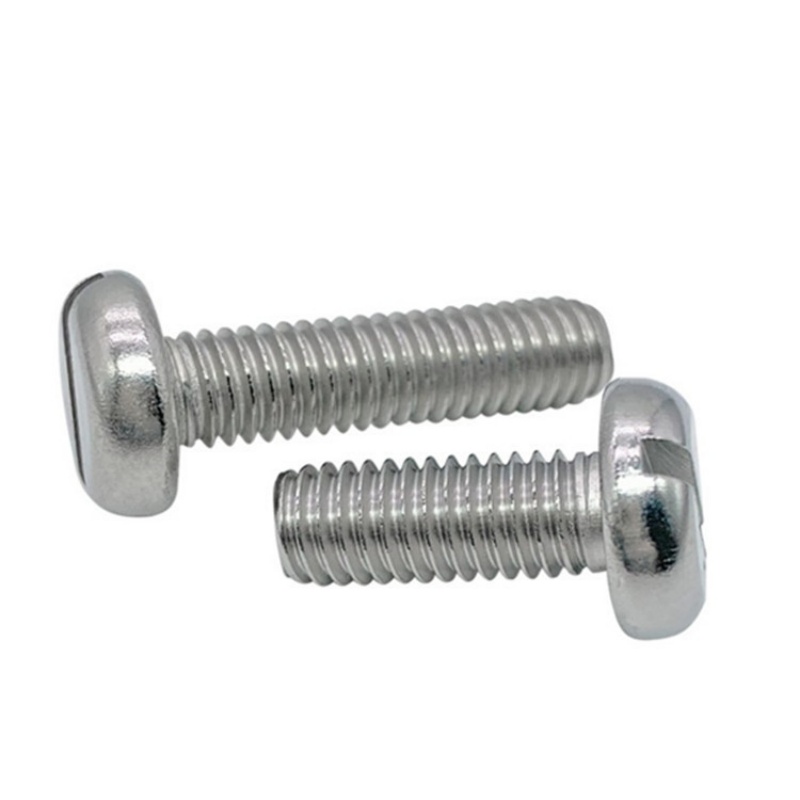 DIN 85:1988 Pan Head Slotted ScrewLow domed pan-head slotted screw for standardized assembly; blade fit depends on slot width and depth, so dimensional clarity supports inspection and maintenance.View Product →
Sourcing checklist for slotted screws
A complete inquiry for slotted screws carries six lines of information, and anything missing becomes a clarification email or a rejected lot.
Head style and standard edition, for example countersunk to DIN 963:1990.
Thread size, pitch and length, stated as nominal diameter by length.
Property class or stainless grade, plus any hardness or tensile requirement.
Finish and coating specification, including plating thickness where relevant.
Slot width n where a fixed driver or torque tool is already in use.
Packaging, marking and lot traceability needs, including carton counts.
Beyond the list, ask for a first-article sample from the same production lot as the bulk order. Slotted heads hide small deviations well in a photograph, but a sample plus a pin gauge will show whether the slot width and depth are where the standard requires them to be.
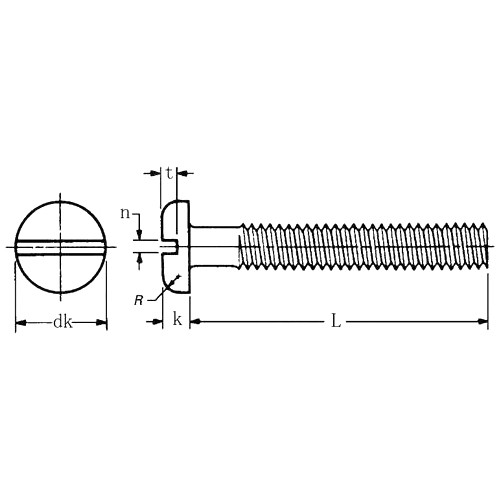 ASME/ANSI B18.6.3:2010 Pan Head Slotted ScrewInch-standard pan-head slotted screw for U.S.-standard and cross-regional projects; a first-article sample helps verify slot width and depth before bulk ordering.View Product →
One-line RFQ template: DIN 963:1990, M4 x 16, A2-70, plain finish, 20,000 pcs, boxed 500.
Frequently asked questions
Are slotted screws still standardised?
Yes. DIN 84, DIN 85, DIN 963 and DIN 964 remain active in metric catalogues, ISO 1207, ISO 1580, ISO 2009 and ISO 2010 cover the main head shapes, and ASME B18.6.3 still defines inch slotted machine screws. Availability is broad in small and mid sizes and thinner at the extremes.
What driver size fits a slotted M5 screw?
For a cheese head screw to ISO 1207, the slot width at M5 is typically 1.2 mm, while pan and countersunk heads can differ. Match the tip width to the slot width, keep the tip thickness below the slot depth, and confirm the value on the governing standard or drawing.
Why do slotted heads strip so easily?
Only two slot walls transmit torque, and a worn or undersized blade contacts the slot edges instead of seating in the bottom. Replacing the blade and controlling tightening torque prevents most of the damage seen in service.
Can slotted screws run on automated assembly?
They can, but the blade must be aligned before engagement, cycle times rise, and cam-out risk limits usable torque. Lines with a fixed takt time normally justify a recessed or internal drive instead.
Send the standard with its year, head style, size, grade, finish and packing in one message, and most slotted screw quotes can be confirmed without a second round of questions.
OUR PRODUCTS
Related Products
CONTACT DETAILS
-
 Address:Room 1901-4, Building 1, Eastern Chuangzhi Mansion, Baiyang Street, Qiantang District, Hangzhou City, Zhejiang Province, China
-
 phone:+86-0571 85382212
-
 E-Mail:export@betterfastener.com
-
 Whatsapp:+86 15372362589
QUICK LINK
PRODUCTS
QR CODE
Copyright © 2026 Better Fastener Industry Co., Ltd. All Rights Reserved. Fastener Manufacturers in China Custom Fastener Factory


