

 English
  Español
  عربى
عربى 
Hexagon Head Bolts: Standards, Grades, Wrench Sizes and Inspection Checks
Content
That mismatch is why experienced buyers specify hexagon head bolts by standard, property class and thread length instead of by diameter alone. The six-sided head is the one part of the fastener that has to satisfy handling tooling, torque specification and hole clearance at the same time, and all three of those are fixed by published standards rather than by personal preference.
What Counts as a Hexagon Head Bolt
A hexagon head bolt is a threaded fastener with a six-sided head, a cylindrical shank and an external thread, tightened by turning the head with a wrench or socket rather than a screwdriver.
Definition: a bolt passes through clearance holes in the parts being joined and is secured with a nut, while a screw threads into a tapped hole in one of those parts. Either one can carry a hexagon head, which is why the two words are used interchangeably on drawings, in catalogues and in warehouse conversation.
The distinction still matters at the receiving desk. A drawing that calls for an ASME B18.2.1 hex cap screw is asking for a bolt in everyday language but a screw in the standard's own wording, and that head carries a washer face which a hex bolt made to another standard may not have. If the terminology keeps causing friction between engineering and purchasing, our note on what a bolt actually is walks through the definitions one by one.
Head dimensions are not open to negotiation. Head height, across flats, across corners, thread length and the radius of the fillet under the head are all fixed by published standards, and the same nominal size can differ from one standard family to the next.
| Standard | System | Thread form | Where it turns up |
| ISO 4014 | Metric | Partial thread | Current metric default for machine building |
| ISO 4017 | Metric | Full thread | Thin stacks and flexible grip lengths |
| DIN 931 and DIN 933 | Metric | Partial and full | Legacy drawings with older DIN wrench sizes |
| DIN 960 and DIN 961 | Metric | Fine thread | Vibration-prone joints and thin-walled parts |
| ASME B18.2.1 | Inch | UNC and UNF | North American equipment, washer-faced head |
| ASME B18.2.3.5M | Metric | Metric coarse and fine | North American drawings with metric threads |
| JIS B 1180 | Metric | Coarse and fine | Japanese machinery, small hex heads available |
Equipment built to North American drawings but cut with metric threads is a common trap, because the head looks identical to an ISO item and measures differently at the corners. The ASME B18.2.3.5M pattern is the direct answer to that drawing.
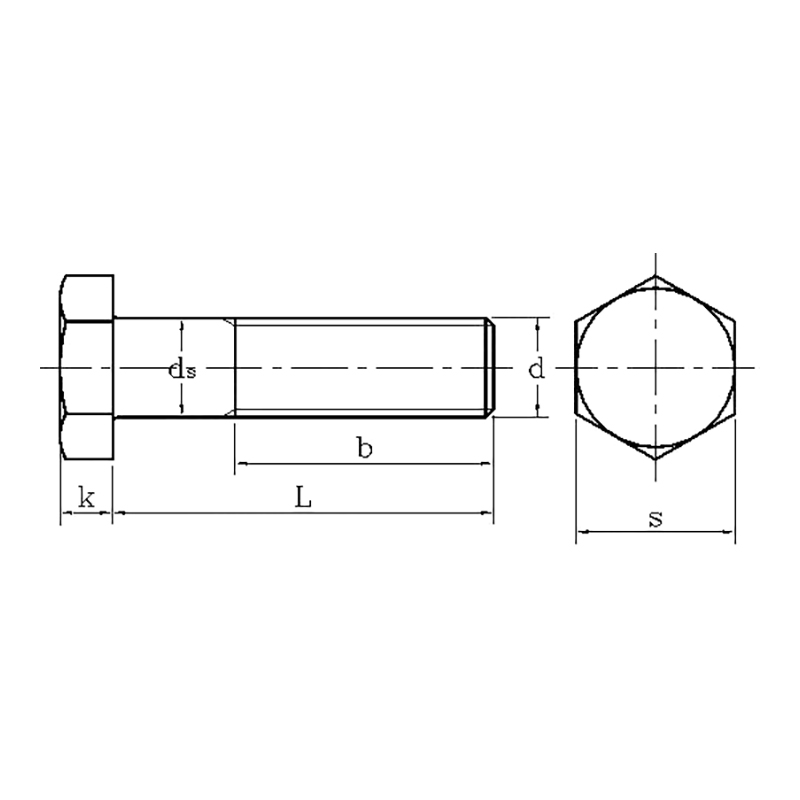 ASME/ANSI B18.2.3.5M:2006 Metric Hex Head BoltASME/ANSI B18.2.3.5M:2006 Metric Hex Head Bolt follows the ASME/ANSI metric standard system and is suitable for international equipment, export projects, and engineeri...View Product →
Thread Length and Wrench Size on the Shop Floor
Partially threaded hex bolts such as DIN 931 and ISO 4014 are the default where the unthreaded shank has to carry shear load, while fully threaded bolts such as DIN 933 and ISO 4017 suit thin stacks and a wide spread of grip lengths.
- Unthreaded shank bears on the hole wall, so shear and bearing strength stay high
- Better fatigue behaviour because the first loaded thread sits outside the joint
- Grip length must be calculated before the order is placed
- Thread length runs about 2d plus 6 mm on common metric sizes
- Nut position is flexible, which reduces the number of lengths kept in stock
- Thread crosses the shear plane, so the load-bearing area is smaller
- Widely used in electrical, HVAC and light structural assemblies
- Easier to source in small quantities and mixed lengths
Grip length is where most partial-thread orders go wrong. The unthreaded shank has to span the full thickness of the clamped parts, and the thread has to be long enough for the nut and washer to reach full engagement without the shank running out of thread inside the nut.
| Nominal size | Across flats, ISO 4014 and 4017 | Across flats, legacy DIN 931 and 933 | Socket change |
| M10 | 16 mm | 17 mm | Yes |
| M12 | 18 mm | 19 mm | Yes |
| M14 | 21 mm | 22 mm | Yes |
| M22 | 34 mm | 32 mm | Yes |
| M16 and M20 | 24 mm and 30 mm | 24 mm and 30 mm | No |
Because mixed inventories are so common, it helps to buy from a catalogue that separates standard families clearly. The full range of hexagon head bolts spans metric, inch, fine thread and heavy hex patterns, so a substitution can be checked against the correct standard edition rather than against a photograph.
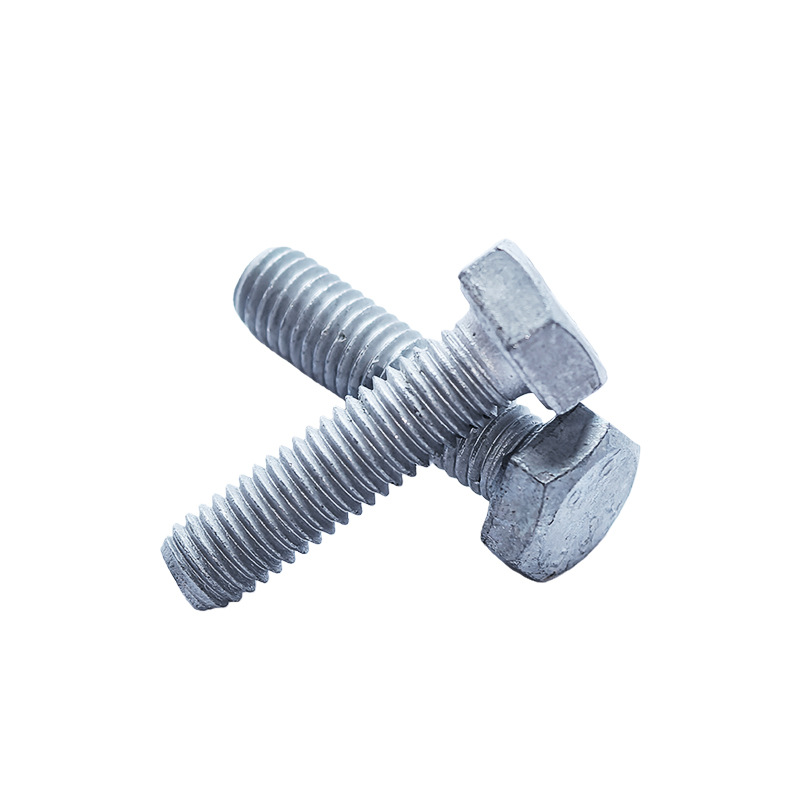 DIN 933:1987 Fully Threaded Grade A/B Hex Head BoltDIN 933:1987 Fully Threaded Grade A/B Hex Head Bolt is suitable for joints that require a long thread adjustment range. Its fully threaded body can cover different cla...View Product →
Property Classes, Materials and Failure Points
Property class, not head shape, sets the load a hexagon head bolt can carry. Class 8.8 delivers a nominal tensile strength of 800 MPa and a minimum proof strength of 640 MPa for diameters up to M16, class 10.9 moves that to 1040 MPa and 940 MPa, and class 12.9 reaches 1220 MPa and 1100 MPa.
Class also drives material and finish. Class 8.8 is normally medium carbon steel with electroplated zinc between 5 and 12 micrometres. Classes 10.9 and 12.9 use quenched and tempered alloy steel, finished in black oxide or zinc flake rather than thick plating. Stainless A2 and A4 grades cover corrosion exposure, and A4 with its molybdenum content is the safer pick where chlorides, road salt or coastal air are present.
Hydrogen embrittlement is the quiet risk in high-strength plating. Electroplated fasteners at class 10.9 and above need a post-plating bake, and a coating specification that does not mention it can still pass dimensional inspection and then crack days after installation.
Heavy hex and structural bolting
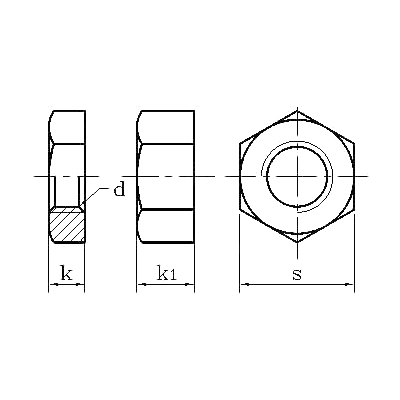
Structural steelwork uses a different animal. DIN 6914 heavy hex bolts pair with DIN 6915 nuts and DIN 6916 washers. The head is wider across flats than a standard ISO head so the wrench can apply high preload without rounding the corners, and the thread length is shortened so the thread never sits in the shear plane. The current European equivalent lives in the EN 14399 series, and tension control variants are installed with a shear wrench instead of a torque wrench.
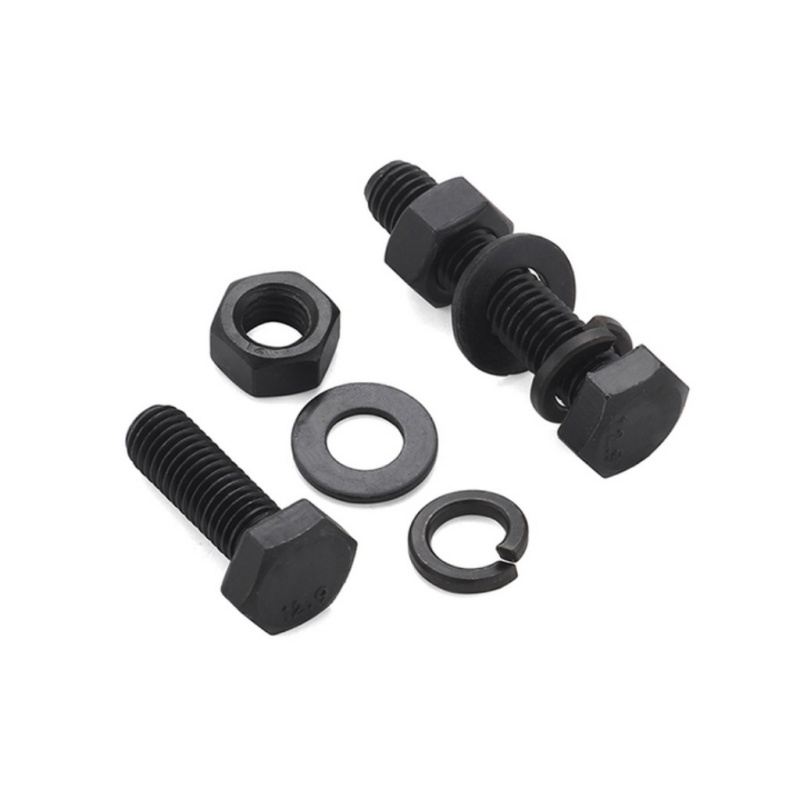 DIN 6914:1989 Structural High Strength Heavy Hex BoltDIN 6914:1989 Structural High Strength Heavy Hex Bolt is intended for high-strength structural steel connections. Its larger head size helps transfer stable tightening...View Product →
Fatigue starts under the head
When a hexagon head bolt fails in a vibrating assembly, the crack almost always starts at the fillet radius between the head and the shank. A rolled thread is stronger than a cut thread at the same class because the rolling process leaves compressive stress at the thread root, and an undercut or damaged fillet will shorten service life long before the grade on the head becomes the limiting factor.
Sourcing and Inspection Checklist
Incoming inspection of hexagon head bolts should confirm four measurable things before anything reaches a bin: thread fit, head dimensions, property class marking and coating.
- Read the head marking. Property class, manufacturer identification and, where required, the thread class or left-hand designation are stamped on the head to ISO 898-1.
- Gauge the thread with go and no-go ring gauges. Standard external threads run at tolerance class 6g, which is the medium fit most drawings assume.
- Measure across flats and across corners against the exact standard edition on the drawing, not against a sample from a previous shipment.
- Check head height, fillet radius and the squareness of the bearing face. A tilted bearing face loses preload as soon as the joint is loaded.
- Confirm coating type and thickness, then verify that the friction condition matches the torque value being used on the line.
- Ask for the heat lot and material certificates, and for mechanical test reports covering tensile, wedge and hardness results.
Torque figures are only valid for the friction condition they were calculated for. Change the plating, add a lubricant or fit a hardened washer, and the same torque produces a different preload on the same bolt.
Most disputes over hexagon head bolts come back to one of two things: a standard edition that was assumed rather than confirmed, or a coating change that altered friction without anyone updating the assembly instructions. Both are inexpensive to prevent at the quotation stage and expensive to correct on a finished joint.
Frequently Asked Questions
What is the difference between a hex bolt and a hex cap screw?
Both have a six-sided head. A hex bolt is intended to pass through clearance holes and be tightened with a nut, while a hex cap screw is designed to thread into a tapped hole. ASME B18.2.1 hex cap screws also carry a washer face under the head and hold tighter body diameter tolerances than the same size of hex bolt.
What does 8.8 stamped on a hexagon head bolt mean?
The first number is one hundredth of the nominal tensile strength in MPa, so 8.8 corresponds to 800 MPa. The second number is the ratio between yield and tensile strength, giving a minimum proof strength of 640 MPa for diameters up to M16. It says nothing about the coating or the thread length.
Which hexagon head bolt should be used for structural steelwork?
Use heavy hex structural bolts rather than standard hex bolts. DIN 6914 with matching DIN 6915 nuts and DIN 6916 washers, or the equivalent EN 14399 assemblies, are designed for high preload and have a short thread length that keeps the thread clear of the shear plane.
Coarse thread or fine thread hex bolts?
Coarse thread is standard practice for steel and cast iron because it resists cross-threading and assembles faster. Fine thread gives a higher minor diameter and better resistance to vibration loosening, which is why it shows up on thin-walled parts, precision machinery and joints that see repeated dynamic loading.
Key takeaway: specify hexagon head bolts by standard edition, property class and thread length together. Diameter alone does not tell a supplier which wrench the assembly line needs, and it does not tell the line how much load the joint can carry.
OUR PRODUCTS
Related Products
CONTACT DETAILS
-
 Address:Room 1901-4, Building 1, Eastern Chuangzhi Mansion, Baiyang Street, Qiantang District, Hangzhou City, Zhejiang Province, China
-
 phone:+86-0571 85382212
-
 E-Mail:export@betterfastener.com
-
 Whatsapp:+86 15372362589
QUICK LINK
PRODUCTS
QR CODE
Copyright © 2026 Better Fastener Industry Co., Ltd. All Rights Reserved. Fastener Manufacturers in China Custom Fastener Factory



