


 English
 Español
 عربى
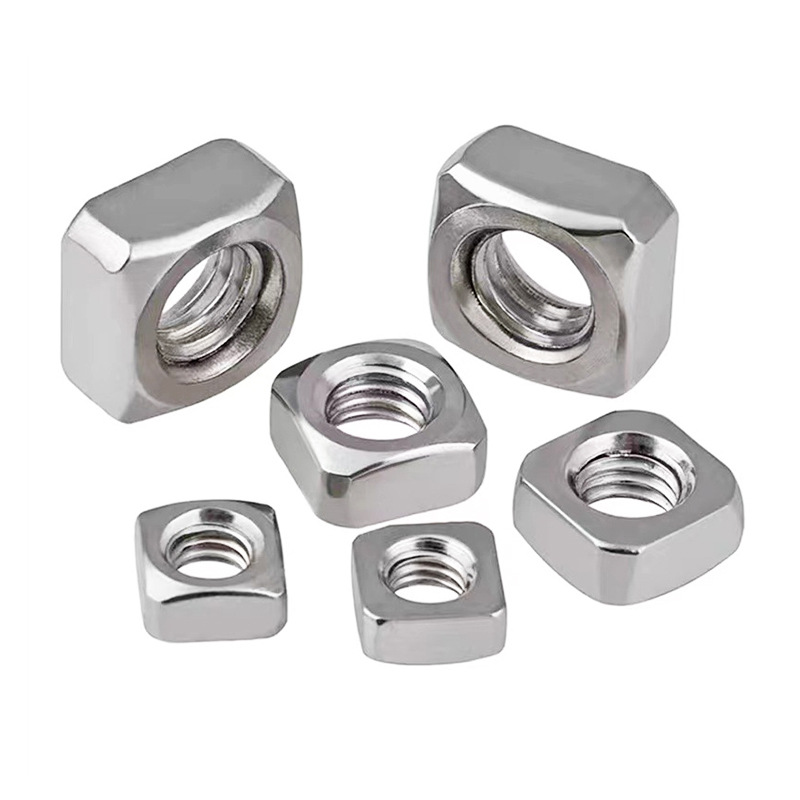


Better Fastener Industry Co., Ltd. is a Square Nuts manufacturer in China producing four-sided nuts in carbon steel and stainless steel to DIN 557, DIN 562 and ASME/ANSI B18.2.2 dimensions. The range is built for assemblies where a hex nut cannot be held: T-slots in aluminium profiles, square pockets in castings, mould and fixture plates, and channel sections where the nut must stay put while the bolt is driven from the opposite side.
Because the flat sides of a square nut bear against parallel walls, tightening torque is reacted by the slot rather than by a second wrench. That single geometric property drives most of the applications we quote, and it also determines the tolerances, materials and surface finishes we recommend.
Our Square Nut Range
We produce square nuts as part of a broader Nuts programme that also covers hexagon, flange, lock, acorn, slotted, wing, spring, round, wheel and T-nut families. Square nuts sit alongside these as the anti-rotation option, and we regularly supply them as a matched set with bolts and washers from the same production chain.
| Type | Reference Standard | Typical Material | Where It Fits |
|---|---|---|---|
| Square nut, Grade C | DIN 557 | Carbon steel, zinc plated or hot-dip galvanized | General structural and machine building, slot retention |
| Square nut, thin pattern | DIN 562 | Carbon steel, stainless steel | Low-clearance pockets, sheet metal and panel work |
| Square nut, inch series | ASME/ANSI B18.2.2 (T2) | Carbon steel, stainless steel 304 / 316 | North American equipment, replacement and OEM builds |
| Square nut, stainless | DIN 557 / DIN 562 equivalent | A2 / A4 stainless steel | Wet, coastal and food-adjacent environments |
| Square nut, drawing-specific | Customer drawing or sample | Carbon, stainless, low-alloy steel | Non-standard widths, thicknesses and thread lengths |
Why Square Nuts Are Specified
The four-sided profile does three things a hexagon cannot do as cleanly. It locks into a slot or pocket so the nut cannot rotate; it presents a wider flat bearing face that spreads clamping load over a larger area; and it allows assembly from one side only, which matters in enclosed frames and welded structures.
- Slot and channel retention — flat sides mate with T-slots in aluminium profiles, mould bases and machine fixtures, so the bolt can be tightened without holding the nut.
- Load distribution — the larger bearing area reduces contact stress on softer substrates such as aluminium sheet, plastics and composite panels.
- Anti-rotation in castings — square pockets in cast or fabricated parts capture the corners and remove the need for secondary anti-spin features.
- Single-side access — useful where the reverse face is inaccessible after welding, cladding or assembly.
Materials, Threads and Finishes
Square nuts are produced in carbon steel and stainless steel, with low-alloy steel available for higher-strength requirements. Threads are normally coarse metric or unified inch series, with fine pitch and left-hand threads on request. Surface treatment is selected against the service environment rather than as a default.
- Zinc plating — standard corrosion protection for indoor and sheltered industrial use.
- Hot-dip galvanizing — for outdoor structures, poles and frames exposed to weather.
- Blackening — for machine tools, fixtures and visible assemblies where a dark finish is preferred.
- Plain / passivated stainless — A2 and A4 grades for wet, coastal and chemical-adjacent service.
Where a square nut is used with a plated bolt, we match the coating system so that galvanic pairing and thread fit remain consistent across the joint. Square nuts are commonly paired with Square Head Bolts in timber and heavy frame work, and with Hexagon Head Bolts where a standard hex head is used on the accessible side.
Sizes, Tolerances and Dimensional Control
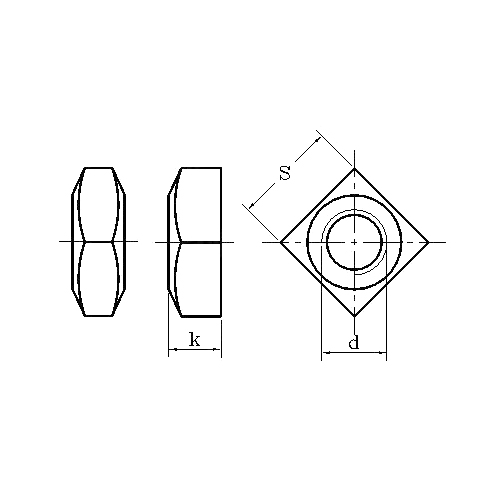
Square nut dimensions are defined by across-flats width, nut height and thread size. For slot-mounted applications the across-flats tolerance is the critical dimension, because the nut must slide into the slot without binding yet still be captured when torque is applied. We confirm the slot width, the nut width and the intended clearance before releasing a drawing.
| Control Point | What We Confirm | Why It Matters |
|---|---|---|
| Across-flats width | Nominal width and tolerance band against the slot | Prevents binding or free rotation in the channel |
| Nut height | Standard or thin pattern to suit pocket depth | Controls thread engagement and clearance |
| Thread class | Metric or inch class per drawing | Determines fit with the mating bolt |
| Bearing face flatness | Squareness of the face to the thread axis | Even load transfer into the clamped part |
| Coating thickness | Plating or galvanizing build-up on threads | Keeps assembly torque predictable |
Quality Assurance and Acceptance
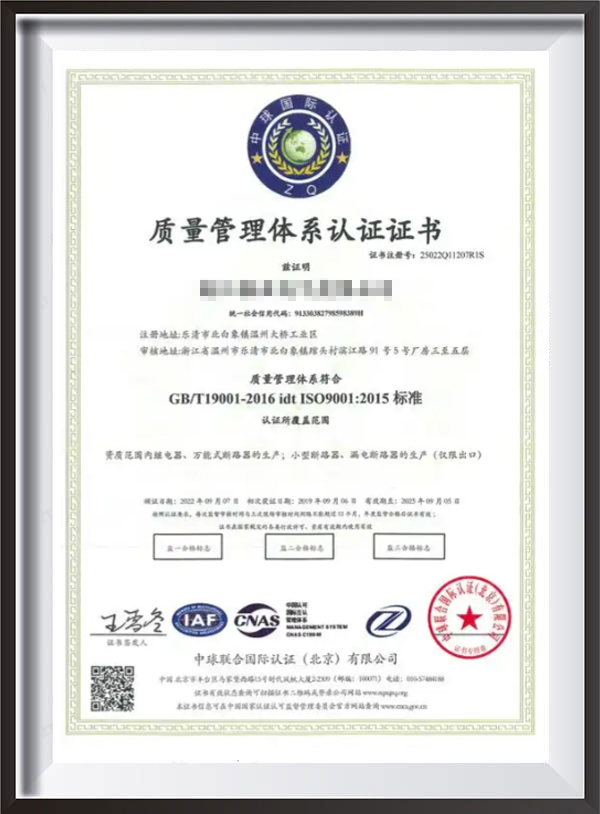
Square nuts pass through in-process inspection and a final inspection stage before packing. Our laboratory is equipped with a spectrometer for chemical composition, a coordinate measuring machine for geometry, and X-ray flaw detection for internal soundness, supported by mechanical property testing. Dimensional checks cover across-flats width, height, thread gauge fit and bearing face condition.
Acceptance documentation is agreed at order stage. Depending on the project this can include material certificates, dimensional inspection records, coating thickness results and hardness or tensile data. Where a third-party inspection or a specific sampling plan is required, we build it into the production schedule rather than treating it as a separate operation.
Custom Square Nuts and Drawing-Based Production
Non-standard square nuts are a core part of what we make. We develop from customer drawings or physical samples, adjusting across-flats width, height, thread length, chamfer and material to suit the pocket or slot in the mating part. Typical custom work includes oversize square nuts for timber frames, thin square nuts for low-clearance panels, and square nuts with a reduced thread length for blind pockets.
- Width, height and thread combinations outside the standard tables
- Left-hand threads and fine pitch threads
- Special coatings, including hot-dip galvanizing and blackening
- Matched supply with bolts and washers from the same production chain
Packaging, Delivery and Documentation
Square nuts are supplied in bulk cartons, small retail kits, blister packs or custom boxes depending on the sales channel. Export cartons are sized for container loading, and we can consolidate square nuts with other fastener lines so that a project arrives as a single shipment. Our location is within a short drive of Shanghai and Ningbo ports, which supports both sea freight and, for urgent requirements, air freight.
Documentation follows the agreed scope: packing list, material and inspection certificates, and any labelling or barcode requirements specified for the receiving warehouse.
Information We Use to Configure Your Solution
A workable quotation for square nuts depends on a small set of inputs. When these are clear, we can confirm the standard, material, finish and packing without a second round of questions.
- Standard or drawing — DIN 557, DIN 562, ASME/ANSI B18.2.2, or a customer drawing with dimensions.
- Thread size and pitch — metric or inch, coarse or fine, right or left hand.
- Material grade — carbon steel, low-alloy steel, or stainless A2 / A4.
- Surface finish — plain, zinc plated, hot-dip galvanized or blackened.
- Slot or pocket dimensions — the width the nut must sit in, and the available depth.
- Quantity and delivery pattern — single release or scheduled call-offs.
- Inspection and documentation — certificates, sampling plan and any third-party inspection.
- Packaging format — bulk carton, retail kit or custom box.
Frequently Asked Questions
What is the difference between DIN 557 and DIN 562 square nuts?
DIN 557 covers the standard square nut with a full-height body, while DIN 562 covers a thin pattern with reduced height. The thin version is used where pocket depth or overall stack height is limited, but it offers less thread engagement, so the bolt length and load case need to be checked together.
Can you supply square nuts in stainless steel for outdoor use?
Yes. We produce square nuts in A2 and A4 stainless steel for wet, coastal and chemical-adjacent environments, and in carbon steel with hot-dip galvanizing where a galvanized finish is preferred. We match the coating or grade to the mating bolt to avoid an unfavourable galvanic pairing.
How do I choose the across-flats width for a T-slot?
Start from the slot width and the clearance you can accept. The nut must slide freely into the slot but be captured when torque is applied, so the width tolerance band matters as much as the nominal size. Send us the slot width and depth and we will confirm the matching nut width and height.
Do you produce non-standard square nuts from drawings?
We develop square nuts from customer drawings or samples, including non-standard widths, heights, thread lengths and coatings. A drawing or sample with the critical dimensions marked is enough for us to prepare a configuration and quotation.
What inspection documents can be supplied with a square nut order?
Depending on the agreed scope, we can provide material certificates, dimensional inspection records, coating thickness results and mechanical property data. Third-party inspection can be scheduled into production where the project requires it.
Can square nuts be supplied together with bolts and washers?
Yes. Square nuts can be consolidated with bolts and washers from our wider fastener range so that a project arrives as a single, matched shipment, with packaging configured for the receiving warehouse or retail channel.





