

 English
 Español
 عربى

Lock Washers Explained: Split Ring, Tooth, and Wedge Types for Industrial Buyers
Content
A drawing calls out lock washer, M8, zinc plated, the first shipment arrives as split rings, and six months later the same joint is loose again and the maintenance team blames the part. The washer was not defective. The name on the drawing was simply too vague to describe the geometry that joint needed.
Definition. A lock washer is a washer whose geometry creates spring tension, friction, or a mechanical bite at the bearing surface so a bolted joint loses preload more slowly under vibration, thermal cycling, or material settling. It does not create clamp load in a correctly torqued bolt; it protects the clamp load that is already there.
What a lock washer actually does
A lock washer resists loosening by interrupting one of the two paths that let a fastener come apart: relative rotation at the threads, or straight loss of clamp load through the joint.
Two mechanisms carry most of that work. The first is stored spring energy. A split ring, wave washer or curved washer is compressed at installation and keeps pushing back against the bolt head, so as the joint settles there is still axial force holding the assembly together. The second is a mechanical bite. Tooth washers have raised teeth that press into the bearing surface and add a large amount of friction against rotation, while wedge-lock pairs use matched cam faces to convert vibration into extra preload instead of loosening.
Split, wave and curved profiles store axial energy and release it as the joint settles.
DIN 6797 A and J profiles grip the face and raise breakaway friction against rotation.
DIN 25201 cams push preload upward when the joint tries to rotate loose.
A common expectation is that a lock washer will stop a bolt from turning at all. That is not what the part is for, and joints designed on that assumption usually fail in service rather than in the first week.
Rule of thumb: a lock washer buys time, not immunity. If a joint is losing preload through gasket creep or a long thermal cycle, no washer geometry will fix it, and the joint design has to change before the fastener does.
The five families you will be quoted
Five geometries cover nearly every lock washer enquiry that reaches a supplier: split ring, wave or curved, external tooth, internal tooth, and wedge-lock pairs.
| Family | How it works | Common standard | Best fit | Watch for |
| Split ring | Axial spring with offset ends | DIN 127, ASME B18.21.1 | Steel-to-steel joints with moderate vibration | Bites into soft faces; can crack under over-compression |
| Wave or curved | Light axial spring over a wide face | DIN 137 A or B, DIN 128 A | Short clamp length, plastic take-up | Low spring force; not for heavy shock |
| External tooth | Radial teeth grip the outer diameter | DIN 6797 A | Small screws, earthing contacts, painted parts | One-time use; scratches plating |
| Internal tooth | Teeth grip around the hole, hidden | DIN 6797 J | Small heads, visible surfaces | Less bite on oversized holes |
| Wedge lock pair | Matched cam faces raise preload | DIN 25201 | High-vibration machinery and safety joints | Must be fitted in pairs and in the correct order |
Material and finish are the second half of the specification. A zinc plated spring washer behaves quite differently from a stainless A2 tooth washer when the bolt is stainless and the joint sits outdoors, and the difference shows up as galvanic corrosion rather than as a torque problem. If the terminology in a request is unclear, a broader overview of washer types is a useful starting point before narrowing to a standard number.
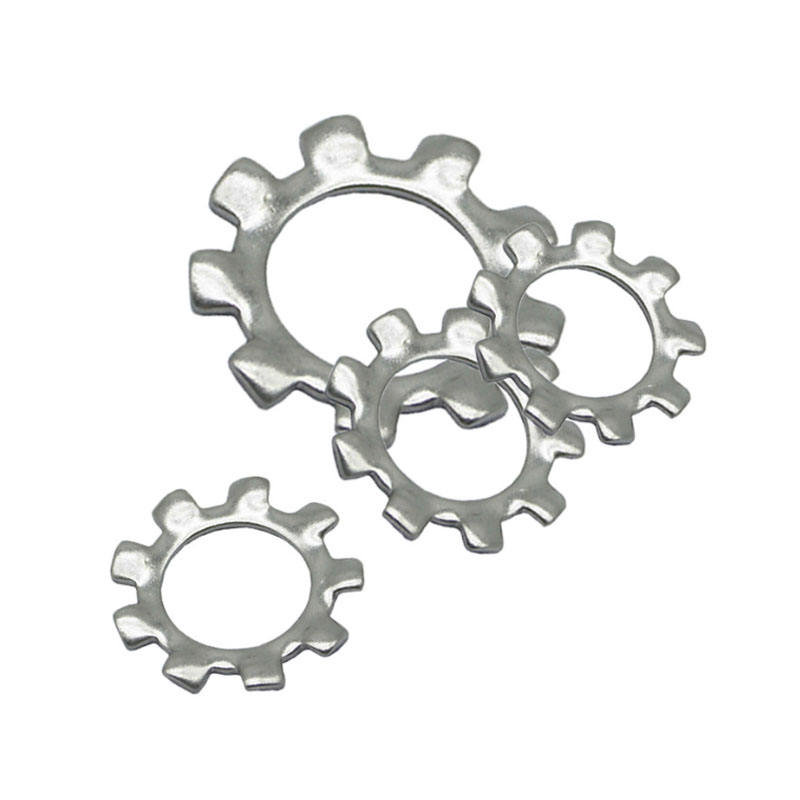 DIN 6797 A External Tooth Lock WashersExternal-tooth lock washers available in carbon steel, stainless steel and plated versions; specify material, finish, tooth count and thickness for the joint.View Product →
Ask for the year, not just the number. Two suppliers can both quote DIN 6797 A and still ship different tooth counts and thicknesses, because the standard fixes the profile family rather than every dimension a designer cares about. A drawing settles it in one email.
Matching the washer to the joint
Start with the bearing surface: hard steel suits a spring or wedge, soft aluminium or plastic needs a wide contact face, and a painted or plated surface needs a tooth profile that can still cut through the coating.
Split ring
- Works best between hardened steel faces
- Keeps axial tension after the joint settles
- Needs a flat, full-contact seat under the head
Tooth washer
- Grips painted, plated and coated surfaces
- Adds friction against rotation rather than lift
- Sacrificial: replace it on every rebuild
Hole condition decides as much as load does. A washer sitting over a slot, an oversized clearance hole or a countersunk seat has almost no bearing area, so the spring never reaches its working height and the tooth never contacts metal. On small screw heads and visible panels, an internal tooth washer keeps the grip hidden inside the head footprint while still biting into the base material.
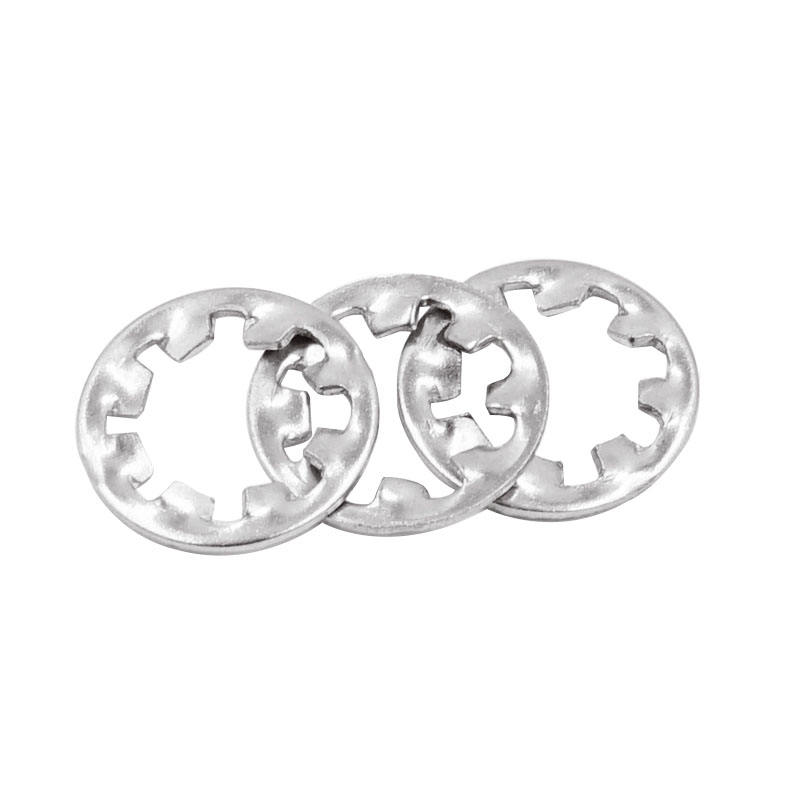 DIN 6797 J Internal Tooth Lock WashersInternal-tooth lock washers suit small screw heads and limited outer clearance, keeping grip inside the head footprint while biting the contact surface.View Product →
Do not stack a split ring on top of a flat washer and expect more holding power. The flat washer adds a compliant layer that the ring simply deforms, and the assembly ends up with less preload than a plain bolt and washer would have had.
Preload, torque and installation mistakes
A lock washer only protects clamp load that still exists, so installation practice decides whether the part does anything at all.
- Check mating hardness. A soft washer under a high grade bolt flattens before the bolt reaches its target torque, and the tooth or spring never engages.
- Confirm the seat is flat, round and free of burrs. A radius or a weld spatter under the washer tilts the head and eats preload.
- Torque to the joint specification, not to the washer. Lock washers change friction, so torque values may need recalculation rather than reuse.
- Re-check after the first thermal or load cycle. Settling in the first hours is normal; a second pass recovers the lost fraction.
The ranking is practical experience from maintenance and assembly work, not a laboratory test report. Your joint geometry, surface finish and torque strategy will move these bars.
Standards, finishes and purchase order details
A complete lock washer order needs five fields: standard and year, nominal size, material grade, finish, and packaging, because two suppliers can ship visibly different parts under the same generic name.
| Standard | Part | Typical use |
| DIN 127 | Helical spring washer | General machinery, steel joints |
| DIN 128 A | Curved spring washer | Light axial take-up on short bolts |
| DIN 137 A or B | Wave spring washer | Bearing preload, thin assemblies |
| DIN 6797 A and J | External and internal tooth | Earthing, small screws, cosmetic panels |
| DIN 9250 S | Spring lock washer, square ends | Heavier spring washers on large bolts |
| DIN 25201 | Wedge lock washer system | High vibration, safety-relevant joints |
Finishing is where most disputes start. Electroplated zinc on high strength washers carries a hydrogen risk unless the parts are baked, hot dip galvanising adds thickness that changes the fit inside a recess, and stainless A4 is the safer answer for wash-down and coastal work. Every family in our catalogue can be quoted against a named standard, a drawing, or both.
- Standard, revision year and nominal diameter, for example DIN 6797 A 1988, M8
- Material and hardness range, not just the word steel
- Finish with a coating thickness or salt spray expectation
- Packaging and marking, particularly for mixed-size cartons
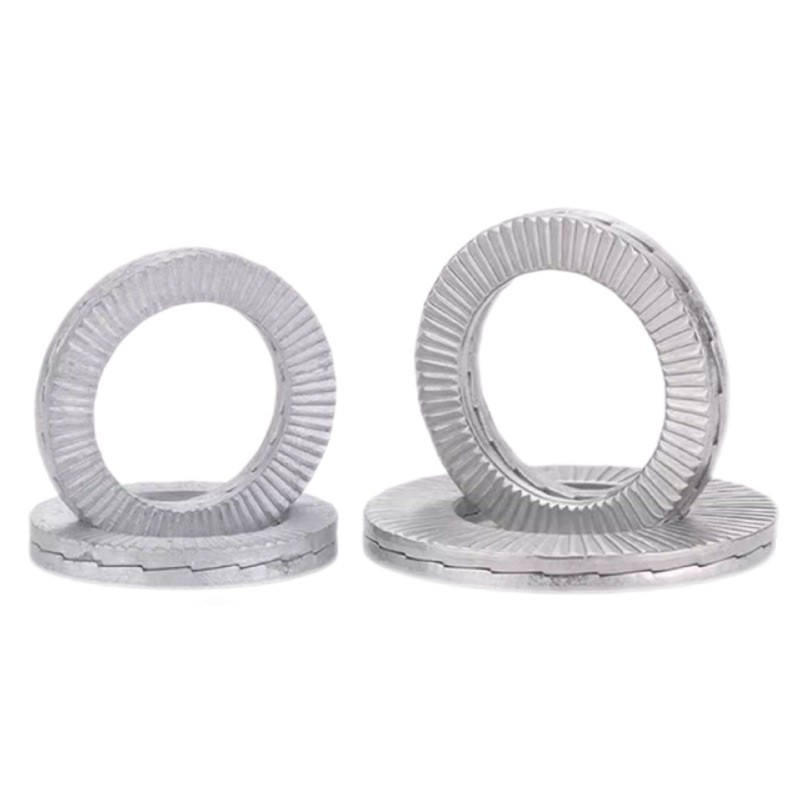 DIN 25201 Paired Self-Locking Washer SetsPaired wedge-locking washer sets for high-vibration joints, available in carbon and stainless steel; confirm standard year, hardness and seating surface.View Product →
One line on the drawing saves a claim. Adding the standard year, the hardness range and the seating surface requirement to a lock washer callout prevents the most common mismatch we see in incoming inspection.
Frequently asked questions
Do lock washers really stop bolts from loosening?
They slow loosening rather than stop it. A split ring or tooth washer adds friction and keeps some axial tension, which delays rotation under vibration. On joints with heavy shock or a large thermal swing, a wedge-lock pair or a thread-locking compound holds preload far more reliably than a spring washer alone.
Are split lock washers and spring washers the same part?
In everyday buying language, yes: the split helical ring is sold as both a split lock washer and a spring washer. The standards separate them more carefully. DIN 127 covers the helical spring washer, DIN 9250 covers a square-ended spring lock washer, and wave or curved washers are a separate family with much lighter spring force.
Should a lock washer be used together with a flat washer?
Usually not in series. A flat washer under a tooth washer spreads the bite over a wider area and reduces grip, and a split ring placed on a soft flat washer simply deforms it. Use a flat washer when the hole is oversized or the material is soft, and place the lock washer directly against the surface it is meant to grip.
Which material suits outdoor or stainless assemblies?
Match the washer to the bolt and to the environment. Choose A2 or A4 stainless for outdoor and wash-down joints, zinc-flake or mechanically plated steel where hydrogen embrittlement is a risk on high strength parts, and an isolating washer where stainless meets aluminium to slow galvanic corrosion.
If a joint has already failed twice with a lock washer in place, send the bolt grade, the surface condition and the torque value. The washer is usually the last variable to change, not the first.
OUR PRODUCTS
Related Products
CONTACT DETAILS
-
 Address:Room 1901-4, Building 1, Eastern Chuangzhi Mansion, Baiyang Street, Qiantang District, Hangzhou City, Zhejiang Province, China
-
 phone:+86-0571 85382212
-
 E-Mail:export@betterfastener.com
-
 Whatsapp:+86 15372362589
QUICK LINK
PRODUCTS
QR CODE
Copyright © 2026 Better Fastener Industry Co., Ltd. All Rights Reserved. Fastener Manufacturers in China Custom Fastener Factory



