

 English
 Español
 عربى

Acorn Nuts: Standards, Dome Depth, Materials and Sourcing Checks for Buyers
Content
On a guardrail, a retail display or the top mount of a shock absorber, the last few millimetres of thread are the part that catches hands, fabric and weather. An acorn nut closes that end: a hex body with a domed cap that covers the protruding thread completely.
The compromise lands on the drawing rather than on the shelf. The dome consumes usable thread length, so the bolt has to finish inside the cap instead of pushing through it. Get that clearance wrong and the nut seats against nothing while the torque wrench still clicks.
What an Acorn Nut Actually Is
An acorn nut is a nut with one closed, dome-shaped end that encloses the end of a mating thread. The dome is a cover; the hex body carries the load.
Every load path runs through the hex body and the engaged threads inside it, which makes usable engagement shorter than on a plain hex nut of the same overall height. Bolt length therefore matters more here than in ordinary nut selection: the thread must end below the dome shoulder while enough engaged turns remain in the body to carry the clamp load. A bolt that bottoms out inside the dome produces the worst kind of failure, because the joint feels tight and measures tight while the clamp load sits close to zero.
Capping a thread does three practical jobs at once, which is why the part appears far outside decorative work. It is worth reading the basic role a nut plays in a threaded joint before switching a callout from a hex nut to a domed one.
- Safety: no sharp thread end at hand or head height on barriers, gym frames and machine guarding.
- Protection: the thread end stays clear of rain, grit and washdown spray, slowing crevice corrosion at the most exposed point.
- Finish: a consistent plated dome reads as a deliberate detail on visible furniture, fixtures and vehicle trim.
The Standards You Will See Most Often
Three callouts cover most acorn nut demand: DIN 1587 for the standard hexagon domed cap nut, DIN 986 for a domed cap nut with a non-metal insert, and JIS B 1183 for an acorn assembly nut.
| Callout | Dome construction | Locking | Where it fits |
| DIN 1587 | One-piece hex body with a closed dome, heavy pattern available | None | Static joints that need thread cover and a clean visible finish |
| DIN 986 | Domed hex body with a non-metal insert in the upper thread | Prevailing torque from the insert | Equipment with vibration, occasional rework and light locking needs |
| JIS B 1183 | Acorn nut supplied as a matched assembly with its seat | Depends on the assembly | Vehicle and equipment lines ordering a single part number per joint |
Across-flats, overall height and dome radius are not interchangeable across these standards, so a drawing that names one does not accept a substitute without a dimensional review. The most frequent mismatch is dome depth. A JIS assembly nut and a DIN 1587 heavy pattern can both look right on a bench and still differ enough that the customer's existing bolt bottoms out in one and clears easily in the other.
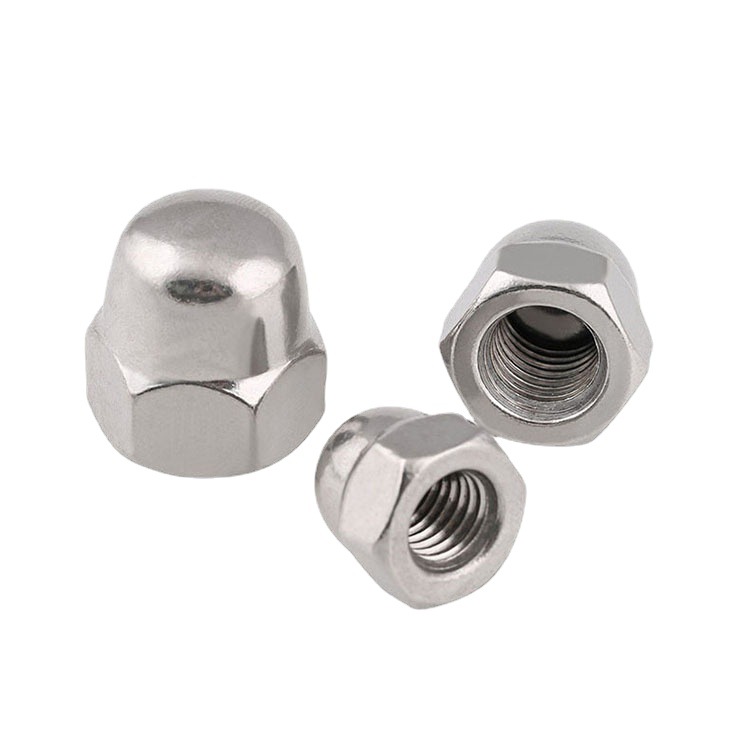
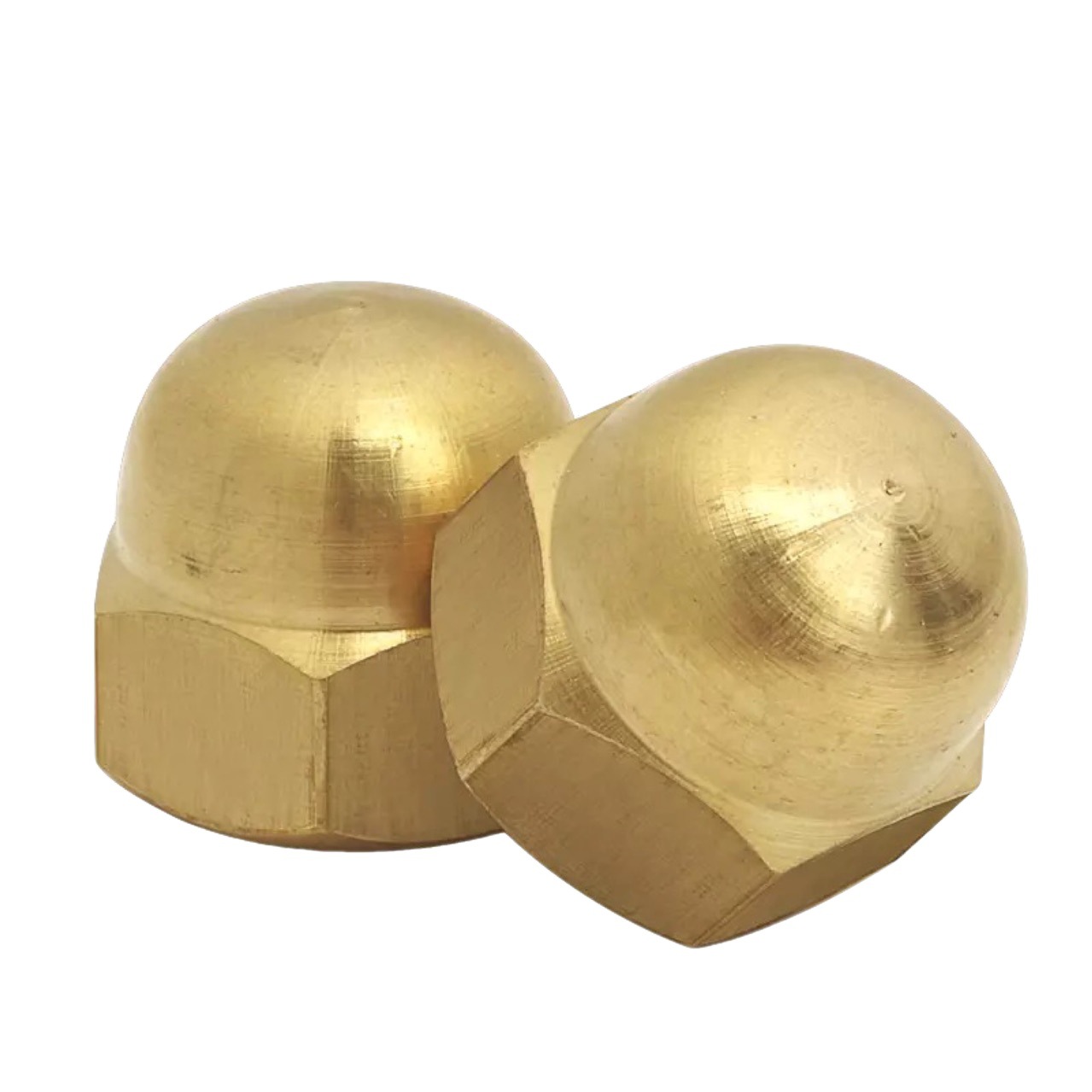 DIN 1587 Heavy Hex Acorn NutHeavy-pattern capped nut protects exposed thread ends and suits visible assemblies; check dome depth and dimensions against the drawing.View Product →
Insert Types and Assembly Styles
A domed nut with a non-metal insert keeps the capping function and adds a light locking element, which is why it lands on vibrating equipment rather than on decorative trim.
The insert sits in the upper body and grips the thread as the nut runs down, creating prevailing torque before the nut seats. Two limits matter in practice. Nylon softens above roughly 100 to 120 degrees Celsius, so exhaust-adjacent or oven-duty joints need an all-metal alternative. The prevailing torque also fades after a handful of reuses, so maintenance instructions should call for replacement rather than a re-torque.
Assembly styles solve a different problem. In an acorn assembly nut, the dome nut arrives as one matched part number with its washer or seat, which removes a line-side picking decision and keeps seat geometry consistent from unit to unit. That is often the real reason a Japanese-origin drawing specifies an assembly rather than a loose nut and a separate washer.
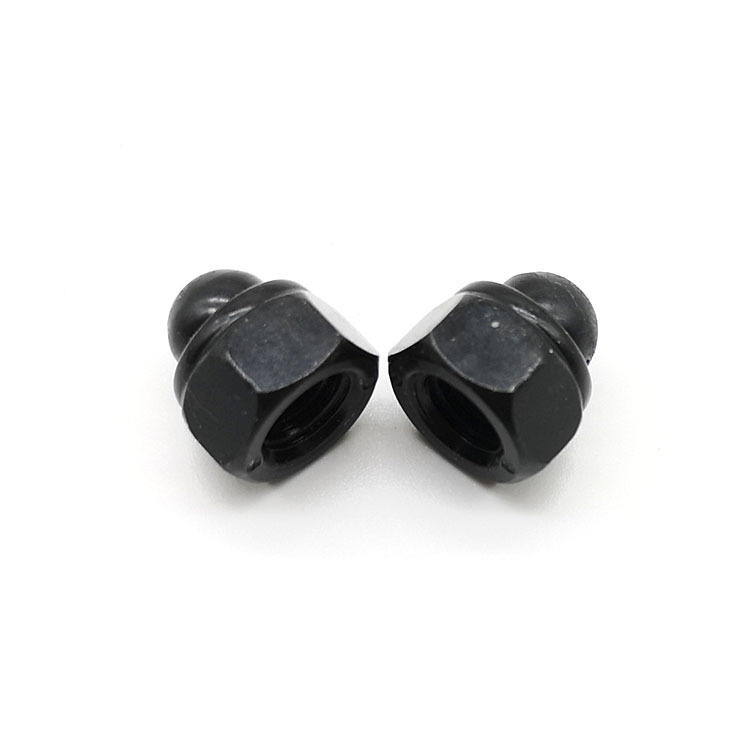 DIN 986 Acorn Nut with Nonmetal InsertCapped nut with nylon insert combines thread-end protection and light locking for visible, vibrating connections; select material and finish for the environment.View Product →
Materials, Finishes and Corrosion Behaviour
Material choice for acorn nuts follows the environment, because a bright dome can hide a thin coating on the threads beneath it.
- Carbon steel, class 8 or class 10, clear or yellow zinc at roughly 8 to 12 micrometres: indoor fixtures, dry machinery, general capping.
- Stainless A2 or A4: coastal structures, washdown areas, food-adjacent equipment and outdoor furniture.
- Brass: terminal studs, instrument hardware and decorative fittings where conductivity or colour drives the choice.
- Chrome or nickel over steel: visible trim and wheel hardware, where appearance is part of the specification rather than an afterthought.
Stainless is the usual answer for marine and washdown service, with one caveat worth printing on the assembly sheet: A2 and A4 threads gall when run dry against stainless bolts, so specify a lubricant or anti-seize compound and control the installation speed.
Acorn Nut or Standard Hex Nut
An acorn nut costs more than a hex nut of the same size and gives up thread engagement, so it earns the difference only when the exposed thread end has to be covered.
Choose the acorn nut when
- Thread ends are reachable by hands, heads or clothing.
- The joint is visible and the finish is part of the product.
- Moisture or grit sitting on bare thread crests is a known problem.
- Bolt protrusion can be controlled at the drawing stage.
Stay with a hex nut when
- The joint is structural and engagement cannot be trimmed.
- Bolt length varies batch to batch and cannot be pinned down.
- Repeated disassembly and re-torque is expected.
- Cost per unit dominates and the thread end is hidden anyway.
Where Acorn Nuts Get Specified
Acorn nuts cluster in four application families, and each one weighs the dome differently.
Wheel and trim fastening is the volume application, and it is also where seat geometry decides the order. A spherical seat nut and a flat seat nut are not interchangeable even when the thread matches, because the seat centres the nut on the wheel face and spreads clamp load evenly around the hole. Ordering a spherical seat part against a flat seat drawing is a return waiting to happen.
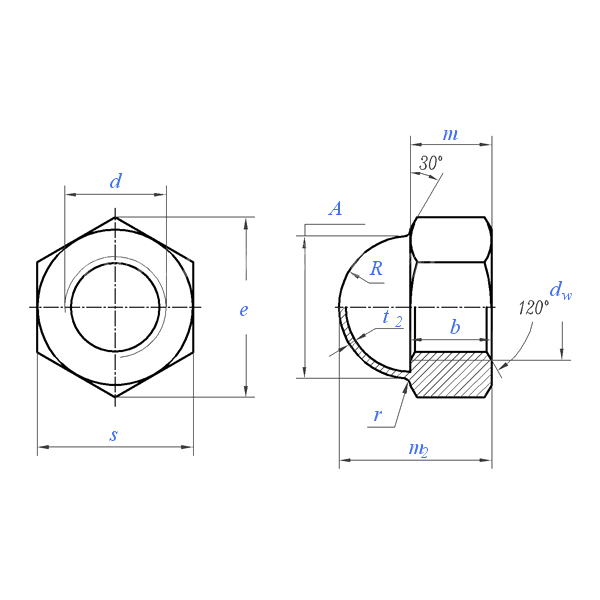 JIS B 1183 Acorn Assembly NutAssembly-style capped nut for Japanese-standard visible fastening, covering thread ends and simplifying installation; confirm seat geometry and dome clearance for the bolt.View Product →
Sourcing Checks That Prevent Returns
Most acorn nut complaints trace back to three things: thread engagement that stops short, plating that fails early, and a dome too shallow for the bolt the customer already stocks.
- Name the standard, the size and the pattern on the purchase order, then confirm the supplier is quoting that exact callout rather than a look-alike.
- State the bolt protrusion, measured from the seating face to the thread end, so the dome cavity is checked at quotation and not at first assembly.
- Fix the finish in numbers: coating type, thickness range and a salt spray target in hours.
- Ask for first-article samples and gauge them, including thread ring gauge and across-flats, before releasing a production run.
- Agree packing and traceability, because a mixed bag of two plating batches is impossible to sort on a customer line.
| Parameter | Put this on the order | What goes wrong without it |
| Standard and size | DIN 1587, M10, heavy pattern, class 8, clear zinc | A lighter pattern or a different dome depth arrives and looks close enough to argue about |
| Bolt protrusion | Thread end to finish 4 mm below the dome shoulder | The bolt bottoms inside the dome and clamp load reads near zero at full torque |
| Coating weight | Zinc 8 to 12 micrometres, salt spray 96 hours | Red rust appears on the dome edge within the first outdoor season |
| Locking behaviour | Non-metal insert, prevailing torque at first and fifth cycle | Vibration loosening on pump brackets and vehicle trim |
| Documents | Dimensional report, material certificate, plating certificate | Claims cannot be traced back to a heat number or a plating batch |
Frequently Asked Questions
Can an acorn nut replace a hex nut in a structural joint?
Only after the engagement is recalculated. The hex body of an acorn nut is usually shorter in usable thread than a standard hex nut of similar height, so a direct swap can cut the engaged turns below what the joint needs. For light capping duty the swap is routine; for structural, high-strength or pressure-retaining joints it needs a check against the drawing and the proof load.
What is the difference between DIN 1587 and DIN 986?
DIN 1587 is the solid one-piece domed cap nut with no locking element. DIN 986 is a domed cap nut fitted with a non-metal insert in the upper thread, so it adds prevailing torque and resists vibration loosening while keeping the closed dome.
What happens if the bolt is too long for the dome?
The bolt end contacts the inside of the dome before the nut seats on the joint face. The wrench then tightens against the dome instead of the clamped parts, which produces a joint that looks correct, measures correct and holds nothing. Shorten the bolt or specify a deeper pattern.
Do acorn nuts need a washer underneath?
It depends on the seat and the mating material. A flat washer spreads load on soft or painted surfaces and protects the finish during tightening, while a spherical or conical seat nut should sit directly on its matching seat. Assembly versions already pair the nut with the correct seat, which is one reason they are specified on vehicle lines.
An acorn nut is a small line item that decides how a joint looks, how it ages and whether someone cuts a hand on it in service. Treat dome depth as a dimension rather than a detail, tie the finish to a measurable coating weight, and the part stops being a source of returns. Our acorn nut range is organised by standard and pattern so the callout on your drawing can be matched directly, from DIN 1587 domed cap nuts through insert versions and JIS assembly styles.
OUR PRODUCTS
Related Products
CONTACT DETAILS
-
 Address:Room 1901-4, Building 1, Eastern Chuangzhi Mansion, Baiyang Street, Qiantang District, Hangzhou City, Zhejiang Province, China
-
 phone:+86-0571 85382212
-
 E-Mail:export@betterfastener.com
-
 Whatsapp:+86 15372362589
QUICK LINK
PRODUCTS
QR CODE
Copyright © 2026 Better Fastener Industry Co., Ltd. All Rights Reserved. Fastener Manufacturers in China Custom Fastener Factory



