

 English
 Español
 عربى

Plain Washers Explained: Standards, Sizes, Materials and Selection Tips
Content
- 1 What a Plain Washer Actually Does
- 2 Plain Washers Versus Spring, Lock and Sealing Washers
- 3 Standards and Dimensions: What Belongs on the Drawing
- 4 Materials, Hardness and Coating
- 5 Heavy Loads, Oversized Holes and Soft Surfaces
- 6 A Five-Step Specification and Inspection Checklist
- 7 Frequently Asked Questions
A plain washer is the cheapest line on a fastener list and the part most likely to be substituted when a project runs late. That substitution is rarely harmless, because a washer that arrives 0.2 mm thin or 100 HV soft changes how a bolted joint behaves long before anything fails visibly.
Consider an ordinary M10 joint. The nut face bears on roughly 15.5 mm of diameter, while a standard DIN 125 washer spreads the same load across 20 mm, which is about 65 percent more bearing area against the steel underneath. On thin sheet, aluminium or painted steel, that difference decides whether the coating survives the first torque cycle or creeps away under load.
This guide covers what plain washers really do, the standards and dimensions that appear on most drawings (DIN 125, DIN 1251, DIN 9021, ISO 7089, ASME B18.22.1 and ASTM F436), how material and hardness should be selected, and the inspection points that catch undersized or wrongly hardened washers before they reach the assembly line.
What a Plain Washer Actually Does
A plain washer is a flat disc with a central clearance hole and no spring, tooth or sealing geometry. Its job is to spread a fastener's clamping load over a larger bearing area, protect the surface beneath it, and bridge slots, burrs and oversized holes.
Nothing in that description involves holding a joint tight. A plain washer does not store elastic energy, does not bite into steel, and does not resist vibration on its own. Judging it by locking performance is a category error; judging it by bearing area, thickness and hardness is the right way to look at it.
- Load spreading: lowers bearing stress under the nut or bolt head, which matters most on aluminium, composites, plastics and thin sheet.
- Surface protection: keeps sockets, nuts and rework from scoring paint, plating and machined faces.
- Hole bridging: covers slotted holes, punched holes with burrs and clearance holes opened up during fit-up.
- Spacing and isolation: fibre, nylon and composite washers separate dissimilar metals and add light sealing or electrical insulation.
Thickness matters more than most buyers expect. A washer sitting at the low end of its thickness tolerance compresses under preload, and the joint loses clamp load as a result. That is exactly why structural specifications such as ASTM F436 pair hardened washers with high-strength bolts, and why soft commercial washers should stay away from 10.9 and 12.9 joints. A shorter version of this explanation is available in the reference note on what a washer actually does.
Plain washer, defined: a flat, circular washer of uniform thickness with a central hole and no locking or spring feature, specified by inner diameter, outer diameter, thickness, material and hardness.
Plain Washers Versus Spring, Lock and Sealing Washers
Plain washers spread load; spring, tooth-lock and sealing washers are separate product families with different geometry and different hardness. Buyers mix them up constantly, usually because all of them are simply called washers on the drawing and all arrive in the same box on the shelf.
Plain washer (flat)
- Flat disc, uniform thickness, no cuts or teeth
- Function: bearing area, surface protection, spacing
- Callouts: DIN 125, DIN 1251, DIN 9021, ISO 7089, ASME B18.22.1, ASTM F436
- Hardness: 100 to 200 HV in general use, 38 to 45 HRC for hardened structural types
Spring and lock washer
- Split, curved or toothed geometry that stores energy or bites the surface
- Function: spring action or friction, not bearing area
- Callouts: DIN 127, DIN 137, DIN 6797, DIN 7980
- Hardness: spring steel, commonly 430 to 530 HV
Sealing washers form a third group. Bonded seals such as DIN 7603, fibre washers and rubber-faced composite gaskets are chosen for fluid or air tightness, and the sealing element sets the temperature, pressure and reuse limits of the whole assembly.
Two rules prevent most mistakes. Never use a spring washer to compensate for a soft bearing surface, and never fit a soft plain washer under a 10.9 or 12.9 bolt in a joint that has to hold preload.
Standards and Dimensions: What Belongs on the Drawing
A complete plain washer callout needs five pieces of information: standard and revision, nominal size, product grade, material or hardness, and coating. The table below lists the callouts that appear on most European, American and Asian drawings together with the hardness ranges normally associated with them.
| Standard or callout | Scope | Typical hardness | Where it is used |
| DIN 125 A / C | General purpose metric flat washer, now largely superseded by DIN EN ISO 7089 and 7090 | 100 to 140 HV | Everyday assembly on painted or plated steel |
| DIN 1251 | Hardened assembly washer with tighter thickness control | About 200 HV | Joints with 8.8 and 10.9 fasteners where preload has to hold |
| DIN 9021 and ISO 7093 | Large outside diameter flat washer | 100 to 140 HV | Soft sheet, plastics, oversized or slotted holes |
| ISO 7089, 7090, 7092 | ISO metric flat washer family in several thicknesses and diameters | 200 HV or 100 HV depending on size | Drawings written to ISO rather than DIN |
| ASME B18.22.1 Type A | Inch plain washers in narrow, regular and wide patterns | Commercial low carbon steel | US-designed equipment; SAE is thin, USS is wide |
| ASTM F436 | Hardened steel structural washer | 38 to 45 HRC | Steel structures and high-strength bolted connections |
Hardness figures here are the commonly published values. Confirm them against the current revision of the standard before writing them into a purchase specification, because several of these documents have been re-issued within the last decade and the tolerances moved with them.
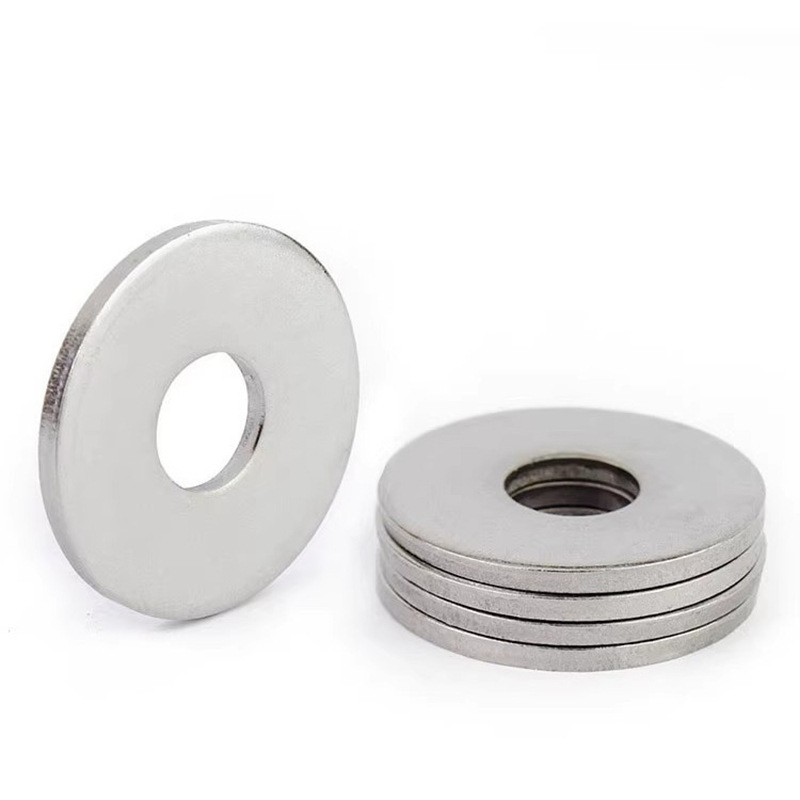 DIN 125-1 Grade A 250HV Flat WasherFlat circular washer for standard bolt-and-nut assemblies, with Grade A dimensions and published hardness values that should be verified against the current DIN standard.View Product →
Dimension watch: an M10 general-purpose washer is normally called out as 10.5 x 20 x 2.0 mm. When the batch arrives at 1.8 mm thickness, the outside diameter still passes inspection, but bearing capacity and the effective grip length of the joint have both changed. Check inner diameter with a pin gauge, outside diameter with a micrometer, and thickness with a flat-anvil micrometer rather than a caliper resting on a burr.
Materials, Hardness and Coating
Material and hardness should follow from the joint: what the washer presses against, how much preload the bolt carries, and what environment the assembly sees. Soft low-carbon steel covers most general assembly work; the moment a joint has to hold preload or sits outdoors, the choice narrows quickly.
Material selection in practice usually comes down to five families:
- Low carbon steel, plain or zinc plated, the default for indoor assembly work.
- Hardened medium carbon steel for structural washers in the 38 to 45 HRC range.
- Stainless steel A2 (304) and A4 (316) for food equipment, marine and chemical exposure.
- Aluminium and brass for electrical contacts, weight-sensitive assemblies and non-magnetic requirements.
- Nylon, PTFE, fibre and composites for insulation, low friction, sealing and protection of soft surfaces.
Coating deserves its own check. Hardened washers that are electroplated above roughly 32 HRC must be baked after plating to reduce hydrogen embrittlement risk, which is why structural orders usually specify a coating standard instead of a colour. Plating thickness, salt spray hours and passivation requirements belong on the purchase order, not in a verbal agreement.
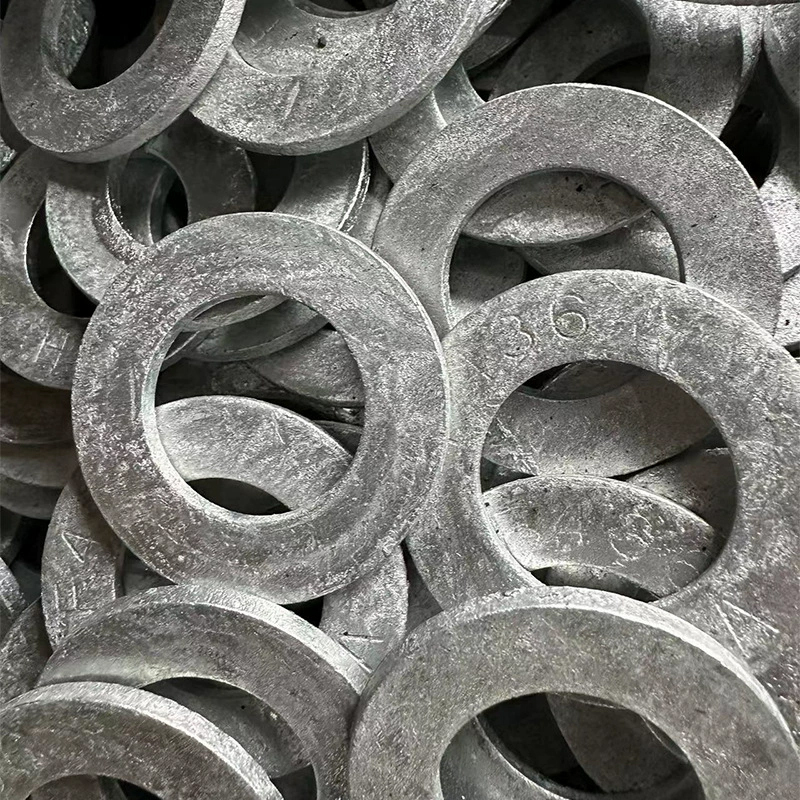 ASTM F 436 2024 Inch Hardened Steel WasherHardened plain washer for inch-series high-strength structural bolting; check coating and hydrogen-embrittlement controls, and select by outside diameter and thickness where bearing surfaces are soft.View Product →
Heavy Loads, Oversized Holes and Soft Surfaces
When the bearing surface is soft or the hole is larger than the fastener, choose the washer by outside diameter and thickness instead of by nominal size alone.
Heavy and structural joints
Heavy flat washers such as DIN 7349 are close to double the thickness of a standard flat washer at the same nominal size, which keeps the washer from dimpling into the joint while adding bearing area. In steelwork, hardened structural washers are matched to the bolt system rather than picked separately, so the washer grade is normally dictated by the connection design.
Oversized holes, timber and repair work
Where a hole has been opened up during fit-up, or where the surface is timber, plastic or thin sheet, outside diameter does the work. Large-diameter flat washers, fender washers and square timber washers such as DIN 436 and DIN 440 exist for exactly that reason, and they are often specified by outside diameter rather than by fastener size.
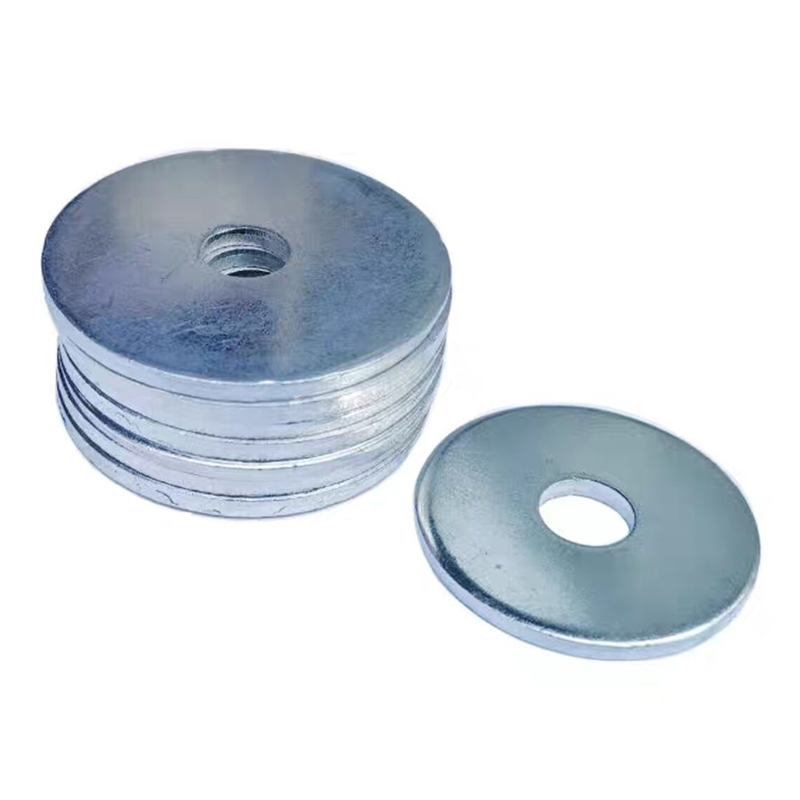 Fender Washer for Oversized Holes and Thin SheetsLarge-outer-diameter plain washer for covering oversized holes and slots in thin sheet, plastic, wood, or repair work; choose by outside diameter and thickness.View Product →
A washer harder than the surface it protects does its job. A washer softer than the bolt it clamps does nothing at all.
A Five-Step Specification and Inspection Checklist
Five checks catch almost every plain washer problem before the parts reach the line.
- Define the joint first. Record the bearing-surface material, the bolt grade, the target preload and whether the joint will be re-torqued. Washer hardness follows from those answers, never from price.
- Write the complete callout. Standard and revision, nominal size, product grade, material and hardness, plus coating specification. A note reading M10 washer, zinc plated will not survive a second order or a second supplier.
- Measure the three dimensions that matter. Inner diameter with a pin gauge, outside diameter with a micrometer, thickness with a flat-anvil micrometer. For structural parts, add a flatness check on a surface plate.
- Verify hardness on the batch, not on the certificate. Vickers or Rockwell testing on a small sample catches mixed stock, and mixed stock is the most common reason soft washers arrive against a hard-washer order.
- Tie documentation and packaging to the job. Material certificates for structural supply, salt spray reports for coated parts, and bulk or small-box packaging matched to how the line actually feeds the parts.
For buyers consolidating suppliers, a manufacturer that already produces washers, nuts and bolts under one roof removes a layer of coordination. BETTER FASTENER INDUSTRY CO., LTD. started as a washer factory in 2001 and expanded into a full fastener line in 2010; the company now supplies steel, stainless, spring and sealing washers alongside nuts, bolts and screws built to DIN, ASME/ANSI, JIS, ISO, GOST, BS, SAE, ASTM and GB/T callouts, with packaging and logistics handled in-house.
Frequently Asked Questions
Are plain washers really necessary?
They are necessary whenever the bearing surface cannot take the nut or bolt-head load, when the hole is larger than the fastener, or when the surface has to stay undamaged. On a hard, flat, machined surface with a matched fastener, a washer adds little. On soft, coated or thin material, it changes the behaviour of the joint.
What is the difference between DIN 125 and DIN 1251 washers?
Both are metric flat washers, but DIN 125 is general purpose and commonly supplied at 100 to 140 HV, while DIN 1251 is an assembly washer hardened to around 200 HV with tighter thickness control. DIN 1251 is the safer choice under 8.8 and 10.9 fasteners where preload has to be retained.
Do plain washers stop bolts from loosening?
Not by themselves. A plain washer has no spring or locking geometry. Loosening is controlled by preload, correct torque, thread condition and, where needed, a locking element such as a nylon-insert nut, an all-metal lock nut or a correctly specified spring washer.
Should the washer go under the bolt head or under the nut?
Whichever end turns is the end that needs protection from galling and surface damage, so a turning nut normally gets a washer. On structural assemblies and on soft materials, washers are often used at both ends, and the drawing plus the relevant bolt standard decides.
OUR PRODUCTS
Related Products
CONTACT DETAILS
-
 Address:Room 1901-4, Building 1, Eastern Chuangzhi Mansion, Baiyang Street, Qiantang District, Hangzhou City, Zhejiang Province, China
-
 phone:+86-0571 85382212
-
 E-Mail:export@betterfastener.com
-
 Whatsapp:+86 15372362589
QUICK LINK
PRODUCTS
QR CODE
Copyright © 2026 Better Fastener Industry Co., Ltd. All Rights Reserved. Fastener Manufacturers in China Custom Fastener Factory



