

 English
 Español
 عربى

Plain Washers Explained: Standards, Sizes, Materials and Sourcing Guide
Content
An M10 bolt torqued to 45 Nm on a 2 mm aluminium panel leaves a visible dent before the wrench ever clicks. The bearing face under a hex head is small, and thin or soft joint materials rarely survive that clamp load on their own.
The part that prevents the damage costs a few cents. A plain washer sits between the fastener and the joint surface, spreads the load over a wider ring, and keeps the head from digging into paint, plating or soft metal. It also bridges slotted, oversized and slightly misaligned holes, which is why it appears on drawings for everything from light fixtures to steel structures.
Buyers still treat plain washers as an afterthought, and that is where small problems start: a washer that meets the drawing but not the hardness call-out, a hole that is one millimetre too large, a shipment quoted against a superseded standard. The sections below cover what plain washers actually do, how the DIN, ANSI and JIS families differ, and what belongs on a purchase order so the parts fit the first time.
What a Plain Washer Actually Does
A plain washer is a flat, unthreaded ring that sits between a fastener head or nut and the joint surface to spread clamp load, protect the material underneath, and cover an oversized or slotted hole.
The geometry looks trivial, but the part performs four separate jobs on the same assembly:
- Load distribution: the ring turns a narrow band of contact under the head into a wider bearing area, keeping compressive stress below the yield point of the joint material.
- Surface protection: painted, plated and composite surfaces are damaged by a rotating head, so the washer takes the wear instead of the finished part.
- Hole bridging: slotted, oversized or slightly misaligned holes are covered by choosing a washer with a larger outer diameter, not by adding a second washer.
- Spacing and clearance: washer thickness sets a repeatable standoff between components, which matters for brackets, covers, and pivoting or sliding joints.
What plain washers do not do is lock a joint. They are not spring washers or serrated lock washers, and stacking two of them does not double the locking effect. If the terminology is still new, the wider family is explained in this overview of washer types and where each one is used.
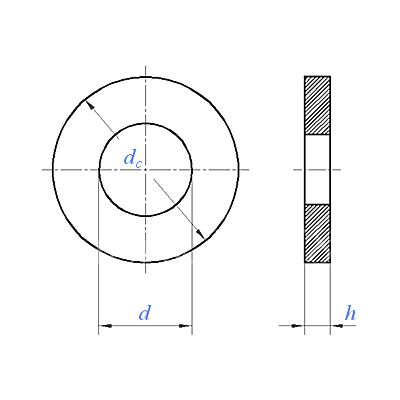 ASME/ANSI B18.21.1 Type A Inch-Series Flat WasherFor general inch-based bearing support and surface protection, this plain washer is sized to ASME/ANSI fasteners and comes in specifications from 0# through 3 in.View Product →
Plain Washer Types and Where Each One Fits
Plain washers are divided by outer diameter, thickness and hardness rather than by brand or price, and those three variables decide which family belongs on an assembly.
| Family | Typical standard | What changes | Where it fits |
| Type A flat washer | ASME B18.21.1 | Inch-series outer diameter and thickness | General machinery, panel and bracket assemblies |
| Metric flat washer | DIN 125 / ISO 7089 | 20 mm outer diameter at M10, 2 mm thick | Steelwork, covers, guards, electrical enclosures |
| Metric flat washer, JIS | JIS B 1256 | Slightly larger outer diameter than the DIN series | Equipment built to Japanese drawings |
| Heavy flat washer | DIN 7349 | Thicker section with a larger bearing face | Slotted holes, castings, soft or uneven surfaces |
| Fender washer | DIN 9021 and similar | Very large outer diameter, thin section | Sheet metal, plastics, timber, repair work |
| Hardened washer | ASTM F436 | Through-hardened steel, high clamp load | Structural bolting and preloaded joints |
| Spherical seat washer | DIN 6319 C and G | Convex and concave pair | Non-parallel or angled bearing surfaces |
Mixing families on the same joint is a common source of rework. A heavy washer and a standard washer in the same size look similar in a bin, but their outer diameters and thicknesses differ enough to change the bearing stress and the grip length of the fastener.
Standards, Dimensions and Tolerances
Every plain washer on a drawing is defined by three dimensions plus a tolerance class: inner diameter, outer diameter and thickness, each with its own permissible range.
The inner diameter is normally 0.2 to 1.0 mm above the nominal bolt size so the washer slides over the thread without binding, while the outer diameter sets how far the load spreads. In practice, outer diameter is where the families diverge most, as the comparison below shows for a single M10 fastener.
Thickness tolerances are usually tighter than buyers expect, because thickness drives grip length. A washer ordered 0.2 mm heavy on an assembly with a fixed bolt length can consume the thread engagement the design relied on, which shows up as a joint that will not reach the specified torque.
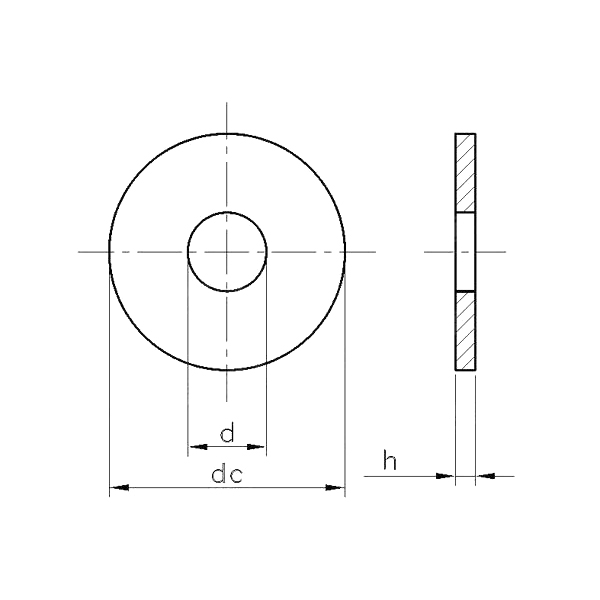 DIN 7349 Heavy Flat Washer for Clamping-Sleeve BoltsThis heavy flat washer supports high clamping loads and larger clearances, with dimensions in mm and material or finish options matched to the assembly environment.View Product →
Material and Coating Selection
Carbon steel with a zinc finish is the default for dry, indoor assemblies, while stainless steel is the default wherever moisture, wash-down, or outdoor weather is part of normal service.
- Higher strength at lower cost, with 200 HV and 300 HV classes available
- Coating protects the surface until it is scratched or cut
- Not suitable for coastal, marine or chemical exposure
- Widely stocked in metric and inch sizes
- Corrosion resistance without a coating, with A4 for chloride environments
- Lower hardness than carbon steel and more prone to galling
- Non-magnetic grades are available for instrument work
- Higher unit cost and longer lead times on non-stock sizes
Non-metallic options solve problems that steel cannot. Nylon and fiber washers insulate electrical assemblies and damp vibration, brass washers combine conductivity with corrosion resistance, and composite gaskets handle sealing duties where a metal ring would leak.
- Clear or blue trivalent zinc for indoor and light outdoor use
- Hot dip galvanized for structural and long-service outdoor joints
- Zinc nickel or PTFE coatings for automotive and high-corrosion areas
- Black oxide for tooling and machine internals where appearance matters
Installation Checks That Prevent Rework
Almost every plain washer problem on a production line traces back to hole size, washer placement, or torque, and all three can be checked in a few minutes.
- Measure the hole, not just the bolt. For an M10 fastener, a close fit hole runs about 10.5 mm, a normal fit about 11 mm, and a loose fit about 12 mm. The washer must cover the hole it sits on.
- Inspect the bearing surface. Remove burrs, weld spatter and paint ridges first, because a washer cannot flatten a raised edge and will cup under load instead.
- Place the washer under the turning element. If the nut turns during tightening, the washer goes under the nut. If the bolt is turned into a tapped hole, it goes under the bolt head.
- Torque after accounting for embedment. Washers settle into softer surfaces in the first minutes, so critical joints should be re-checked after seating rather than assumed to hold the first reading.
- Look for cupping and cracking during inspection. A washer that has domed upward or shows a bright ring on the outer edge has been overloaded for its hardness class.
How to Specify and Source Plain Washers
A plain washer purchase order needs six fields, and a missing one is the most common reason a shipment fails incoming inspection.
- Standard and edition, for example DIN 125 A or ASME B18.21.1-2009
- Nominal size and series, metric M10 or inch 3/8
- Inner diameter and outer diameter with tolerances
- Thickness with tolerance
- Material grade and hardness range in HV or HRC
- Coating type and thickness, plus packaging and marking requirements
For assemblies that combine washers with bolts, nuts or screw-and-washer assemblies, sourcing the full fastener set from one supplier shortens the inspection loop and keeps hardness classes consistent across the joint. The full range of plain washers by standard and size is organised by family, so a specifier can move from DIN 125 to a heavy or hardened version without changing suppliers.
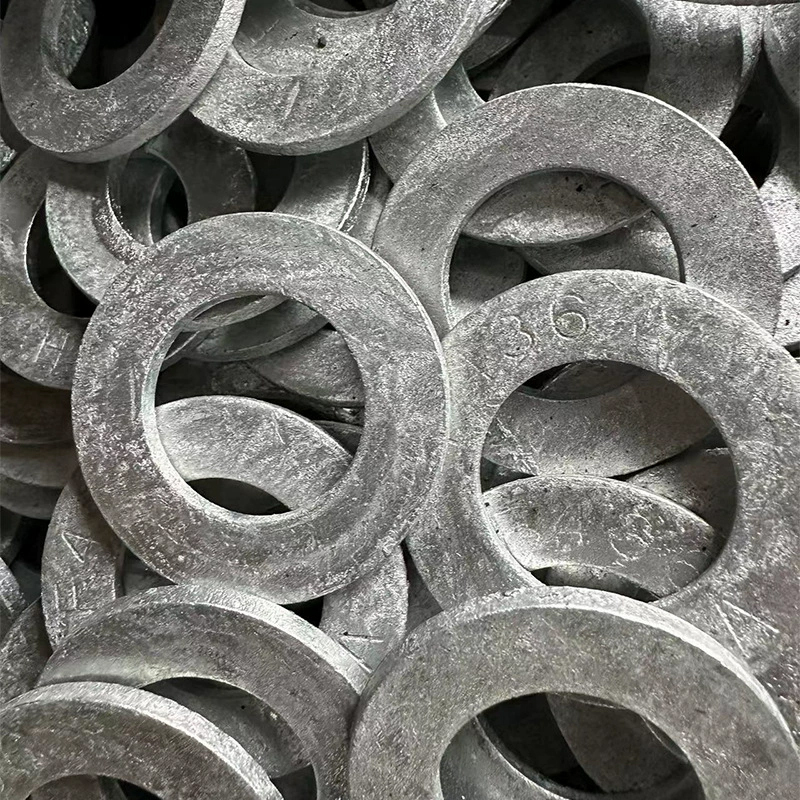 ASTM F 436:2024 Inch Series Hardened Steel WasherFor high-strength inch-series structural bolting, this hardened plain washer helps maintain shape and preload under large loads, with sizes from 1/4 through 4.View Product →
Plain Washer FAQ
What is the difference between a plain washer and a flat washer?
None. Plain washer and flat washer are two names for the same solid annular ring. The distinction that matters is against spring washers, lock washers and serrated washers, which use elasticity or teeth to resist loosening rather than spreading load.
Should the plain washer go under the bolt head or under the nut?
It goes under whichever part turns during tightening. If the nut is rotated onto a fixed bolt, the washer belongs under the nut. If the bolt is rotated into a tapped hole, it belongs under the bolt head. Placing it on the non-turning side leaves the joint surface exposed to the rotating part.
Does a plain washer change the torque I should apply?
It changes the friction under the bearing face, which changes how much of the applied torque becomes clamp load. A dry zinc plated washer and a lubricated or stainless washer can shift the resulting preload by 20 percent or more at the same torque setting, so the torque table should match the coating and lubrication actually used.
When should I choose a heavy plain washer instead of a standard one?
Choose a heavy washer such as DIN 7349 when the joint material is soft, the hole is slotted or oversize, or the bolt is preloaded. The extra thickness and larger bearing face reduce the chance of the washer deforming into the hole and losing preload over time.
Plain washers are simple parts with a short list of variables, and that is exactly why they are worth specifying properly. Get the outer diameter, thickness and hardness right for the joint, and the assembly behaves the way the drawing intended.
OUR PRODUCTS
Related Products
CONTACT DETAILS
-
 Address:Room 1901-4, Building 1, Eastern Chuangzhi Mansion, Baiyang Street, Qiantang District, Hangzhou City, Zhejiang Province, China
-
 phone:+86-0571 85382212
-
 E-Mail:export@betterfastener.com
-
 Whatsapp:+86 15372362589
QUICK LINK
PRODUCTS
QR CODE
Copyright © 2026 Better Fastener Industry Co., Ltd. All Rights Reserved. Fastener Manufacturers in China Custom Fastener Factory



