

 English
  Español
  عربى
عربى 
T-Head Bolts: DIN 188 and ASME B18.5 Sizing, Grades and Clamping Guide
Content
Slide a T-head bolt into a machine table slot, turn it a quarter turn, and it locks against the slot flanges. That one motion is why T-head bolts drive the clamping kits on milling machines, welding tables, hydraulic fixtures and pipe supports, and why a head two millimetres out of tolerance can stall a whole fixture build.
Most drawings arrive with thread, property class and length filled in, while head geometry, nib detail and slot clearance are left to whoever quotes the job. Those three details decide whether the bolt drops in freely, holds torque without spinning, and still releases after a year of coolant and chips.
Definition: a T-head bolt is a threaded fastener with a rectangular head that is longer than it is wide. The head is inserted lengthwise into a T-slot, rotated 90 degrees, and tightened so its shoulders bear on the inner flanges of the slot while the shank projects up through the slot opening.
Everything else follows from that geometry. The bolt never grips the slot walls, it pulls against the underside of the flanges, and it needs no nut on the far side of the table.
What a T-Head Bolt Does That a Hex Bolt Cannot
A T-head bolt turns a machined slot into an adjustable clamping point that needs no access to the underside of the table, which is why it dominates machine tool tables, fixture plates and welding benches.
The mechanism is a 90-degree rotation. The head enters where the undercut is wide enough, the bolt is turned so the long axis of the head spans the undercut, and the nut above the table pulls the head shoulders up against the flanges. The load path stays short: nut, clamped part, flange, head shoulder, shank tension.
Metric T-head bolts for machine tables usually carry a nib, a small square collar forged under the head. The nib drops into the slot opening and blocks rotation while the nut is tightened, so one hand is enough.
The bolt never grips the slot walls. It bears on the underside of the flanges, so head length and bearing area matter more than how tightly the head fits from side to side.
Three ways to clamp into a slot
T-head bolt
One piece, no loose nut under the table, position adjustable along the slot. Best for frequent setup changes. Head size is tied to the slot width.
Hex bolt and slot nut
Flexible and cheap, and the nut can be repositioned anywhere in the slot, but it must be fed in by hand and can be dropped into the machine base.
Hammer-head profile bolt
A lighter family sized for aluminium extrusion slots, often with a spring plate. Fast to position, lower clamping load, smaller bearing area.
Head Geometry: The Five Dimensions That Decide Fit
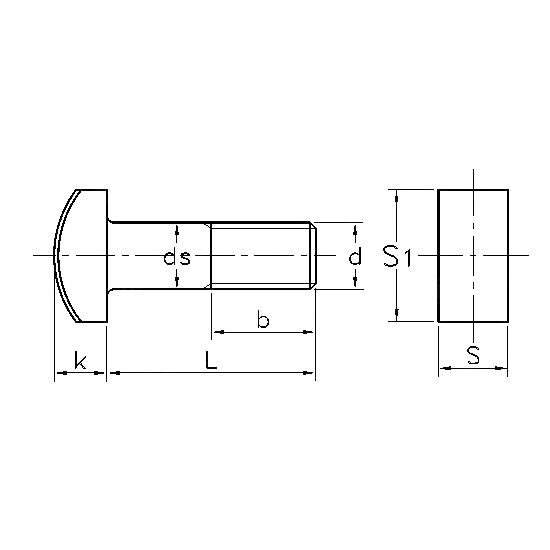
Five dimensions decide whether a T-head bolt works: head width, head length, head height, nib size and the thread length below the head.
Head width is the short side of the rectangle and the dimension that must pass through the narrow slot opening. Head length is the long side and must rotate freely inside the undercut. Head height must sit within the undercut depth without bottoming out.
What to check on an incoming drawing
- Head width with a minus tolerance, so the bolt drops into the slot without tapping.
- Head length long enough for full bearing on both flanges, with room left to rotate in the undercut.
- Head height below the undercut depth, so the head cannot bottom out before preload is reached.
- Nib height and width matched to the slot opening, not copied from an earlier drawing.
- Fillet radius between head and shank called out, instead of being left to the tool room.
If head and thread terms are being checked at the same time, our overview of what a bolt is covers the basic vocabulary first.
Standards and Size Ranges Buyers Actually Order
Two standards cover most T-head bolt enquiries: DIN 188 in metric sizes and ASME B18.5 in the inch series.
DIN 188 defines the metric T-head bolt with a square nib, supplied most often from M8 to M48 in property classes 8.8 and 10.9. The table slot itself is normally controlled by DIN 650, which fixes the slot width series, so the head is chosen to match the table rather than the other way round.
| Standard | Head form | Thread series | Typical range | Common pairing |
| DIN 188 | T-head with square nib | Metric coarse and fine | M8 to M48 | Flange nut or slot nut |
| DIN 188, nib omitted | Plain rectangular head to drawing | Metric | To drawing | Flange nut |
| ASME B18.5 | Inch T-head | UNC and UNF | 1/4 in to 1-1/2 in | Heavy hex nut |
Where a drawing quotes DIN 188 without a tolerance table, head width and head length are the two dimensions to confirm in writing before the first lot runs. Suppliers who reuse one head forging across several slot sizes are the usual reason a clamp will not release.
Materials, Grades and Finishes
Carbon steel in classes 8.8 and 10.9 covers most clamping and fixture work; stainless A2 and A4 take over where coolant, wash-down or outdoor exposure rules out a plated finish.
- Class 8.8 carbon steel, quenched and tempered: machine table clamping, welding fixtures and general jigs.
- Class 10.9 alloy steel: hydraulic clamping and press tooling, where the bolt works close to its elastic limit.
- Class 12.9: the highest common tensile range, but electroplated 12.9 needs a hydrogen embrittlement relief bake, so many lines ship black oxide instead.
- Stainless A2 and A4: food equipment and outdoor pipe supports. Strength is lower and stainless threads gall, so lubricate or use a dissimilar nut.
- Finishes: trivalent zinc for general use, zinc-nickel where salt spray demand is higher, hot dip galvanizing for structural work.
A T-head bolt seldom fails in the thread. When it fails, it fails at the head-to-shank fillet, where a rectangular head concentrates stress. A forged head with a continuous radius carries the load; a head machined from bar with a sharp internal corner starts a crack on the first tightening cycle.
Ask for the grade and manufacturer mark on the head, and for decarburization to be controlled on the bearing face, because a soft skin removes bearing area exactly where the flange contact happens.
Installation, Torque and Pairing
Correct use of a T-head bolt is a four step sequence: clean the slot, insert and rotate the head, seat it against the flanges, then tighten in stages to a torque matched to the property class.
- Clean the slot. Chips, weld spatter and dried coolant stop the head from seating. Brush the slot and check the opening with a gauge first.
- Insert and rotate. Feed the head through the slot end or the loading opening, then turn the bolt 90 degrees so its long axis spans the undercut.
- Seat the head. Slide to position and pull up by hand. A nib type should drop in with a light push; if it needs force, the nib or the slot is out of tolerance.
- Tighten in stages. Fit washer and nut, bring the joint to light preload, then torque. On a long stack, run a second pass after a few minutes.
Reference torque for lightly oiled steel at a friction coefficient near 0.14 is listed below. Treat the figures as a starting point, because the slot material and flange thickness decide how much preload the table can take.
| Thread and class | Reference torque | Typical duty |
| M12 class 8.8 | 86 Nm | General fixture clamping |
| M16 class 8.8 | 210 Nm | Welding tables and machine tables |
| M20 class 8.8 | 410 Nm | Heavy press tooling |
| M16 class 10.9 | 295 Nm | Hydraulic fixtures, if the flange is rated for it |
A T-head bolt is not a slot nut. When the clamp has to slide and lock in the slot, use a slot nut with an ordinary hex bolt. Pairing a T-head bolt with a slot nut leaves nothing to tighten against.
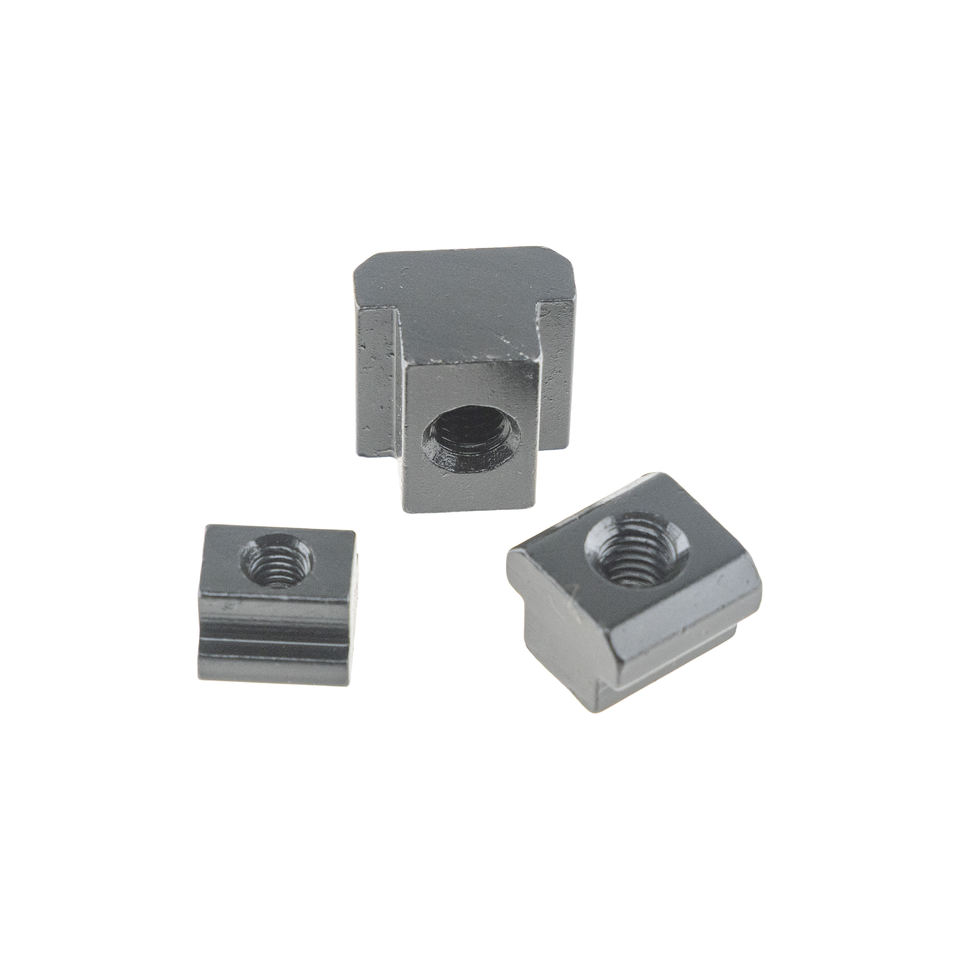 DIN 508:2002 T-Slot Nut for Machine Tool TablesSlides and locates in DIN 650 T-slots to create adjustable clamping points on machine-tool tables, fixture bases, and clamping systems. Pair with ordinary bolts or clamp plates for movable, lockable fixing.View Product →
Sourcing, Inspection and Risk Points
The three defects that reach a customer's dock most often are an undersized head width, a soft or missing nib, and a head that was machined instead of forged.
- Measure head width and length over the full head, not at the midpoint, to catch taper from a worn forging die.
- Check nib height, width and hardness; a nib that shears off lets the bolt spin during tightening.
- Ask for a sectioned sample or macro etch, so grain flow can be seen following the head contour.
- Gauge the thread to a 6g class and confirm the thread length below the head.
- Check flatness and decarburization on the head bearing face.
- Collect an EN 10204 3.1 mill certificate, a dimensional report and a salt spray result with the shipment.
Put the slot standard on the drawing. One line naming DIN 650, or the measured slot width and undercut depth, prevents most of the fit problems we see on clamping bolts. Head dimensions without tolerances invite a supplier to copy a forging that fits a different table.
See the full fastener range to match T-head bolts with the nuts and washers that suit the same slot.
Frequently Asked Questions
What is a T-head bolt used for?
T-head bolts clamp into T-slots on machine tables, fixture plates, welding benches, presses and pipe supports, and on machine platens or test rigs where the clamp point must move along a slot with no access underneath.
How is a T-head bolt different from a hammer-head bolt?
A DIN 188 T-head bolt is sized for machine table slots under DIN 650 and is normally supplied in class 8.8 or 10.9 for high preload. Hammer-head profile bolts fit aluminium extrusion slots, are generally smaller, and carry lighter loads.
What nut goes with a T-head bolt?
A standard hex nut or flange nut, with a plain washer if the clamped part is soft. A slot nut is an alternative to the T-head bolt, not an addition to it, because the head already provides the bearing surface inside the slot.
Can T-head bolts be reused?
Yes, if the head is still square to the shank, the fillet is unmarked and the thread passes a gauge. Replace any bolt torqued past yield, showing deformation at the head fillet, or fitted in a fixture that ran loose.
OUR PRODUCTS
Related Products
CONTACT DETAILS
-
 Address:Room 1901-4, Building 1, Eastern Chuangzhi Mansion, Baiyang Street, Qiantang District, Hangzhou City, Zhejiang Province, China
-
 phone:+86-0571 85382212
-
 E-Mail:export@betterfastener.com
-
 Whatsapp:+86 15372362589
QUICK LINK
PRODUCTS
QR CODE
Copyright © 2026 Better Fastener Industry Co., Ltd. All Rights Reserved. Fastener Manufacturers in China Custom Fastener Factory



